

- Feb, Fri, 2026

The digital marketing landscape is undergoing its most significant transformation since the advent of the smartphone. For two decades, Search Engine Optimization (SEO) followed a relatively predictable playbook: find high-volume keywords, build backlinks, and optimize for a list of ten blue links on a search engine results page (SERP).
Then came the AI Overview.
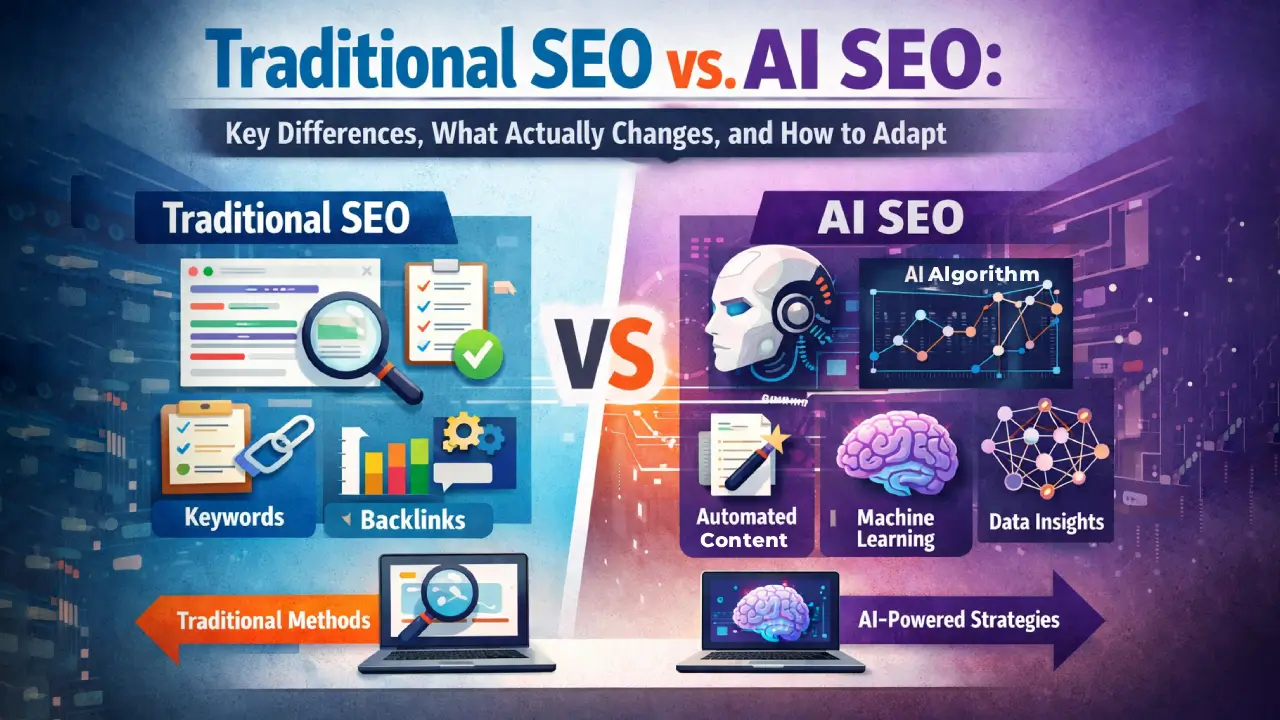
With Google’s integration of generative AI into search, followed by competitors like Bing AI and Perplexity, the rules of discovery have changed overnight. Now, instead of just links, users are presented with comprehensive, AI-generated summaries. This shift has sparked a new debate in the marketing world: Traditional SEO vs. AI SEO.
Is the old way dead? Is the new way just hype? And most importantly, how should you be spending your marketing budget?
In this guide, we will break down the key differences between these two disciplines, explore what actually changes in your daily workflow, and provide a concrete action plan for adapting your strategy. Whether you are handling marketing in-house or looking for professional SEO services, understanding this shift is critical to future-proofing your brand’s visibility.
What Is Traditional SEO?
To understand where we are going, we must first understand where we have been.
Traditional SEO is the practice of optimizing a website to earn higher rankings in the “organic” (non-paid) search results of engines like Google, Bing, and Yahoo. Its primary goal has always been to drive traffic by ranking for specific keywords.
The core pillars of traditional SEO include:
- On-Page SEO: Optimizing content, title tags, meta descriptions, and headers for target keywords.
- Off-Page SEO: Building backlinks (links from other websites) to establish domain authority and trust.
- Technical SEO: Ensuring a website is crawlable, fast, mobile-friendly, and secure (HTTPS).
For years, the mantra was simple: “The website with the best backlinks and the most optimized keyword density wins.”
What Is AI SEO?
AI SEO represents a fundamental shift in focus from rankings to referencability.
AI SEO is the practice of optimizing content so that Artificial Intelligence models—like Google’s Gemini, OpenAI’s ChatGPT, or Perplexity AI—recognize your brand as a trusted, authoritative source to cite in their generated answers.
Because AI models summarize information rather than just listing links, your content needs to be structured for machine reading. The goal is no longer just to get a user to click your link; it is to get the AI to trust your information enough to include your brand in its overview.
This involves:
- Entity Optimization: Helping search engines understand not just your keywords, but who you are as a brand and what topics you are an authority on.
- Structured Data: Using schema markup to explicitly tell AI what your content means (e.g., this is a recipe, this is an FAQ, this is a review).
- Conversational Content: Answering specific questions clearly and concisely to match natural language voice and text queries.
Has Marketing Really Changed?
Before we dive into the technical weeds, we need to address the elephant in the room: Is this actually new, or is it just a rebranding of “good content” practices?
The truth lies somewhere in the middle. The fundamentals of quality have not changed, but the mechanics of discovery have.
If you write thin, inaccurate, or unhelpful content, neither a human nor an AI will recommend you. However, in the past, you could rank a mediocre page if you had enough backlinks. You cannot trick an AI that way.
AI doesn’t just look at your links; it analyzes the clarity, authority, and structure of your information. So yes, marketing has changed. It has evolved from a game of link-building to a game of trust-building.
“Want to dive deeper into how AI algorithms improve rankings? Explore our detailed guide on What is AI SEO and How It Works.“
Key Differences Between Traditional SEO and AI SEO
To effectively market your business, you need to understand the distinct mechanics at play.
1. Discovery Model
- Traditional SEO: Relies on keyword matching. A user types in “best running shoes,” and Google scans its index for pages containing those words.
- AI SEO: Relies on intent and entity matching. The AI interprets the query’s intent, considers the entities involved (e.g., “Nike,” “marathon,” “pronation”), and synthesizes an answer from multiple authoritative sources.
2. Optimization Focus
- Traditional SEO: Focuses on content volume and density. Marketers often aimed for 1500+ word articles with the target keyword appearing a specific number of times.
- AI SEO: Focuses on structure and clarity. AI favors content that is easy to parse, with direct answers under clear headings (H2s and H3s) and the use of lists and tables.
3. Success Metrics
- Traditional SEO: Measures Rankings, Traffic, and Click-Through Rate (CTR) . The ultimate win was a #1 position on page one.
- AI SEO: Measures Visibility and Brand Mentions. The win is being cited as a source within an AI Overview. While this might result in zero clicks initially, it builds massive brand authority.
4. User Experience
- Traditional SEO: Often led to users clicking through to a website to find the answer.
- AI SEO: The answer is often provided instantly in the SERP. The website becomes the source, not the destination.
What Actually Changes When You Incorporate AI SEO?
If you are currently using SEO services or managing an in-house team, you might be wondering how your daily tasks should change. The core work remains, but the strategy behind it shifts significantly.
In Keyword Research and Topic Planning
The Change: You must move from high-volume head terms to conversational questions and topic clusters.
Instead of targeting “best coffee machines,” you need to cover every possible question a user might have: “Which coffee machine is easiest to clean?” “How much does a commercial espresso machine cost?” “Why is my coffee maker leaking?”
AI loves comprehensive topical authority. You don’t just want to rank for a word; you want to own a topic.
In On-Page Optimization
The Change: Structure now trumps style.
The days of the “wall of text” blog post are over. When optimizing your pages, you must prioritize readability for machines.
- Q&A Format: Immediately under your H2 headings, write a concise, factual answer in one to two sentences. Then, you can expand with context. This ensures that if an AI scrapes your page, it finds the answer instantly.
- Clear Headers: Use your H2s and H3s to outline the specific questions your page answers.
In Technical Optimization
The Change: Schema markup becomes non-negotiable.
While technical SEO has always been important, AI SEO relies heavily on structured data. By implementing FAQ, HowTo, and Organization schema, you are essentially handing the AI a cheat sheet that explains exactly what your content means. This significantly increases the chances of your data being pulled into an AI overview.
In Link Building and Brand Mentions
The Change: The focus shifts from “domain rating” to “source authority.”
While backlinks remain a strong trust signal, AI models are also trained on brand mentions in reputable places (news sites, academic journals, industry publications). You need to build a digital PR strategy that gets your brand name cited as an authority, even if those mentions don’t always come with a hyperlink.
How to Track Your Performance
You cannot manage what you cannot measure. As you adapt your strategy, you need a dual-lens approach to analytics.
Track Traditional Metrics That Still Matter
- Organic Traffic: Are people still coming to your site?
- Keyword Rankings: How do you rank for your core terms in the standard “blue link” results?
- Backlinks: Are authoritative sites still linking to you?
Track the Metrics That Matter for AI SEO
- Brand Mentions in AI Responses: Tools are emerging that allow you to see if ChatGPT or Perplexity cites your brand when asked specific questions. This is your new “ranking” report.
- Click-Through Rate from AI Overviews: If Google Search Console shows impressions spiking but clicks dropping, you might be featured in an AI Overview. Track this carefully.
- Share of Voice: Are you being mentioned in conversations across the web, not just on search engines?
Stay Ahead in the AI SEO Revolution
Our experts help businesses transition from traditional SEO to AI-powered strategies that win in modern search results.
How to Adapt Your SEO Strategy for the AI Era
Now that we understand the landscape, let’s look at the tactical steps you can take. If you are looking to hire professional AI SEO Services, ensure they are following these exact principles.
1. Prioritize Clarity and Structure
Don’t make the AI hunt for the answer. Use descriptive headings that act as questions or clear topic statements. Use bullet points and bold text to highlight key takeaways.
2. Write Short, Factual Answers Right Under Each Heading
This is the single most effective tactic for AI optimization. If your H2 is “What is the return policy on shoes?”, the very next sentence should be the answer: “We offer a 30-day return policy on all unworn shoes.” Follow this with the detailed terms. This is often called the “inverted pyramid” style of writing.
3. Write with Intent: Answer Questions Completely
Go beyond the surface level. If you are writing a blog post, look at the “People Also Ask” boxes and the related searches. If your competitors aren’t answering those questions, this is your opportunity to fill the gap and become the most comprehensive source on the topic.
4. Optimize for Both Search Engines and AI Tools
Your content has to serve two masters: the traditional search engine spider and the generative AI scraper. The common denominator is high-quality data. Ensure your content is factually accurate, well-sourced, and up-to-date.
5. Create Content for Humans, Not Just Algorithms
This paradox remains true: If you write for humans with clarity and empathy, you will naturally write in a way that AI can understand. Don’t stuff keywords; just explain your topic thoroughly.
6. Track Your Mentions in AI-Generated Results
Make this a regular part of your reporting. Ask your SEO provider to include a section on “AI Visibility” in their monthly reports. This data will become as important as your Google Analytics numbers.
Frequently Asked Questions
How Do I Optimize for AI Overviews?
To optimize for AI Overviews, focus on providing concise, direct answers to specific questions. Use structured data (schema markup) to help machines understand your content, and build your brand’s authority through mentions in reputable publications.
Is Traditional SEO Dead?
No. Traditional SEO is not dead, but it is evolving. The technical foundation (site speed, mobile usability, security) and the authority signals (backlinks) are still vital. However, the old tactics of keyword stuffing and thin content are obsolete. You now need a hybrid approach that combines traditional foundations with AI-focused clarity.
What’s the ROI Timeline for AI SEO Efforts?
AI SEO is a mid-to-long-term play. While some structured data implementations can yield quick wins in rich results, building the brand authority necessary to be consistently cited by AI models can take 6 to 12 months. It is an investment in brand equity, not just traffic acquisition.
Will AI Replace Traditional Search Engines?
It is unlikely that AI will replace search engines entirely, but it will fundamentally change how we interact with them. Search engines will become answer engines. The “10 blue links” will still exist for transactional queries, but informational queries will increasingly be served by AI summaries.
Conclusion: Combine Both for a Future-Proof Strategy
The debate between Traditional SEO and AI SEO is ultimately a false dichotomy. You do not have to choose one over the other.
Traditional SEO provides the foundation. It ensures your site is technically sound, your pages are indexable, and your brand has the backlink profile to be considered important.
AI SEO provides the visibility. It ensures that once that foundation is laid, the new generation of search engines—the answer engines—can recognize your authority and cite you as a primary source.
To succeed in the next era of digital marketing, you need a strategy that embraces both. Whether you are building your capabilities in-house or partnering with specialized SEO services, the goal remains the same: to be the most trusted source of information in your industry. By adapting your workflow, tracking the right metrics, and writing with clarity and intent, you can ensure that your brand remains visible, referenced, and relevant—no matter how the technology evolves