

- Aug, Thu, 2026

Introduction
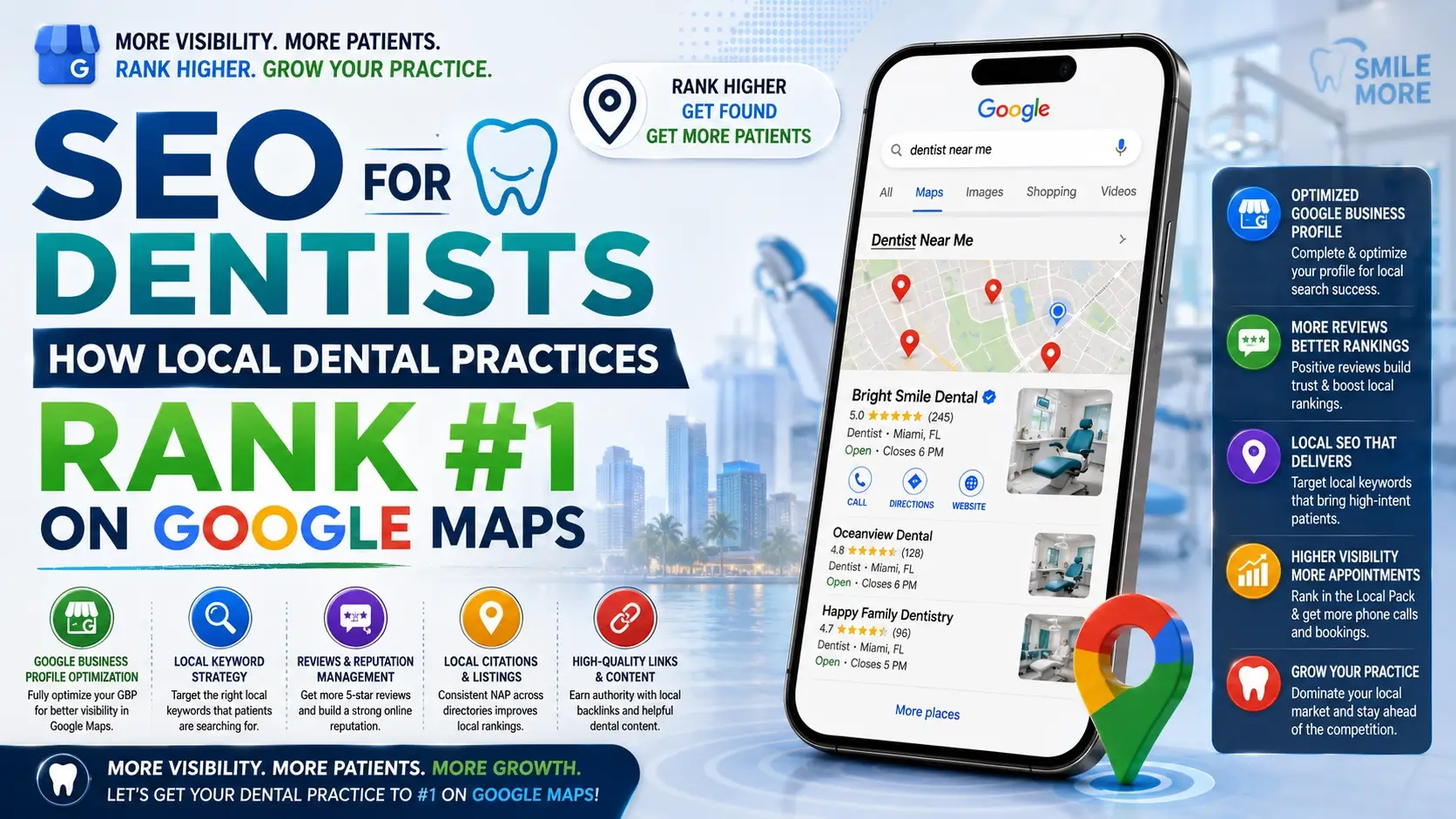
Patients no longer flip through a phone book or ask a neighbor for a dentist recommendation. They open Google, type “dentist near me” or “emergency dentist” plus their city, and choose from whatever appears first. In most cases, that means the Google Maps 3 Pack, a small block of three dental practices shown at the top of the results with a map, star ratings, and a phone number.
This block drives the majority of calls and bookings for local dental practices, often more than the practice’s own website. A dentist who ranks in the 3 Pack gets seen before any competitor buried further down the page, regardless of how strong that competitor’s website might be. Everything in this article focuses on what actually earns a spot in that block.
Choosing the Right Dental Categories
The primary category selected on a Google Business Profile determines which searches a practice becomes eligible to appear in. A general practice listed simply as “Doctor” or “Medical Clinic” will miss dental-specific searches entirely, no matter how good its website is. The primary category needs to read “Dentist” or, where accurate, a more specific option Google offers within the dental field.
Secondary categories expand this reach further. A practice offering teeth whitening and veneers should add “Cosmetic Dentist” as a secondary category. A practice that treats children should add “Pediatric Dentist.” These secondary categories are not decorative. They directly widen the pool of searches a practice can rank for, letting a single profile capture patients searching for general checkups, cosmetic work, and family care all at once.
Practices should review their category selection every few months, since Google periodically introduces new dental specific categories that were not available previously. Switching to a more precise category often produces a visible increase in map impressions within a few weeks.
Multi provider practices sometimes make the mistake of choosing one broad category to cover every specialist on staff. This flattens the profile and makes it harder for Google to match specific searches, such as “orthodontist near me,” to a practice that genuinely offers that service. A practice with an orthodontist, a periodontist, and a general dentist on staff benefits from listing each relevant specialty as a secondary category, since this gives the profile a wider and more accurate footprint across related searches.
Optimizing the Dental Practice Profile
A Google Business Profile only performs at its full potential when every section is filled out, not just the basics. This includes the practice description, a full services list detailing treatments offered, insurance accepted, payment options, and accessibility features such as wheelchair access or parking availability.
Business hours need particular attention in dental practices, since many offer irregular schedules including early morning slots, Saturday appointments, or emergency availability outside standard hours. Google allows practices to list special hours for holidays and separate emergency contact information, and skipping this step causes real friction for patients trying to book urgent care.
For a full walkthrough of setting this up correctly from the first field to the last, our Google Business Profile optimization checklist covers each section step by step, including the parts most practices overlook.
Managing Dental Patient Reviews
Reviews carry more weight for healthcare businesses than for most other industries, since patients are trusting a practice with something personal. Google’s local algorithm favors practices with a steady, ongoing flow of reviews over practices that collect a large batch once and then go quiet for months.
Healthcare businesses face specific limits on how reviews can be requested. Practices cannot offer incentives, discounts, or gifts in exchange for a review, since this violates both Google’s policies and, in many states, healthcare advertising regulations. The safer and more effective method is building a review request into the normal patient checkout process, sending a simple text or email link after each appointment rather than running occasional review campaigns.
Front desk staff play a large role here. A short, natural request made in person at checkout consistently produces more reviews than an automated email sent hours later with no personal context.
Local Citations for Healthcare
A citation is any online listing of a practice’s name, address, and phone number, commonly shortened to NAP data. For dental practices, this includes general local directories as well as healthcare specific platforms such as insurance provider directories, Healthgrades, and Zocdoc.
Consistency matters more than volume. If a practice’s phone number appears one way on its website and a different way on an insurance directory, that mismatch creates confusion for Google’s data matching systems and can quietly suppress ranking confidence in the 3 Pack. Practices should audit their listings across the twenty or so most relevant healthcare and local directories, correcting any mismatched name, address, or phone data rather than chasing hundreds of low value directory submissions.
Practices that have changed address, merged with another office, or rebranded at any point are especially prone to citation drift, since old address data tends to linger on directories that were never updated after the change. A single outdated listing on a high authority directory can hold enough weight to confuse Google’s confidence in the current location, so a full audit after any practice change is worth the time it takes.
On Page SEO for Dental Websites
A dental practice’s website needs to reinforce the same location signals established on its Google Business Profile. This starts with local schema markup, a small piece of code added to the site that explicitly tells Google the practice’s address, phone number, hours, and service area in a machine readable format. This markup helps Google verify that the physical practice location matches what is listed elsewhere online.
Practices serving multiple towns or a wider metro area benefit from dedicated location pages rather than one generic page trying to rank everywhere at once. A practice with two offices in different parts of a city needs two separate location pages, each with its own address, hours, and locally relevant content, rather than a single page listing both addresses at the bottom.
Working with an experienced SEO service provider on this structure often saves months of trial and error, since website architecture mistakes made early are expensive to unwind later. Our dental SEO services are built specifically around this kind of location page structure and technical setup for dental practices.
Patient Engagement Signals
Google tracks how patients interact with a practice’s listing after it appears in search results. Clicks to call, requests for driving directions, and clicks through to book an appointment directly from the map all feed back into the ranking system as engagement data.
A listing that regularly earns calls and direction requests signals to Google that real patients find it useful, which reinforces its position for similar future searches. Practices that enable direct appointment booking through their Google Business Profile, rather than sending patients to a separate contact form, tend to capture more of this engagement, since the path from search result to booked appointment becomes shorter.
Keeping the profile active with regular updates, current photos of the practice and staff, and posts about new services or availability gives patients more reason to interact with the listing directly instead of scrolling past it toward a competitor.
Conclusion
Ranking a dental practice in the Google Maps 3 Pack comes down to a connected set of habits rather than a single fix. Choosing the correct primary and secondary categories, filling out every section of the practice profile, collecting reviews consistently and compliantly, keeping citation data accurate across healthcare directories, reinforcing location signals on the website, and encouraging direct patient engagement all work together as one system.
Most practices see the fastest results by starting with category selection and profile completeness, since both can be corrected within a single sitting. Review consistency and website level signals take longer to build but produce the most durable ranking gains over time.
Local SEO services and dental specific SEO management require ongoing attention, since Google’s local algorithm shifts often enough that a one time setup rarely holds its position for more than a few months. Practices that want this handled on an ongoing basis often turn to a dedicated local SEO Company in USA rather than managing it internally alongside daily patient care. Keyframe Tech Solution provides google my business services, google my business optimization services, and full dental SEO services for practices that want a structured, long term approach to Google Maps visibility. You can review our broader approach to Google My Business optimization services and our full local SEO company in USA offering for practices operating across multiple locations.