

- Mar, Tue, 2026

68%of SERPs now show an AI Overview | 3.4×faster ranking velocity with AI SEO | 47%avg. reduction in manual audit time | 24/7AI monitoring vs. 9-to-5 agencies |
March 2026: The Gap Has Become a Chasm
Here is a scene playing out in boardrooms across India right now: a CMO or Head of Growth opens their monthly SEO report, sees organic traffic stagnating or — worse — declining, and then opens Google to find that their most valuable informational keywords are now dominated by AI Overviews that their content does not appear in. They call their traditional SEO agency. The agency recommends ‘more content’ and ‘better backlinks.’ The CMO ends the call with the uncomfortable feeling that their vendor is still fighting a war that ended two years ago.
We have had this conversation dozens of times in the past six months. And it is not a competence problem on the agency’s part — it is a structural one. Traditional SEO agencies were built for a world where ranking meant climbing a list of ten blue links. That world no longer exists as the primary interface between search and discovery. In its place is a multi-layer ecosystem: AI Overviews, voice responses, visual search, personalized SERPs, and zero-click resolutions — all of which require a fundamentally different set of tools, models, and methodologies.
AI SEO services are not an upgrade to traditional SEO. They are a different discipline with different inputs, different processes, and — as the data increasingly shows — different and superior outcomes. In this article, we document ten specific, technical, and measurable ways that AI-powered SEO solutions are outperforming traditional agencies in 2026. We draw on our own implementation experience at Keyframe Tech Solution and on the performance data we have observed managing clients through the most disruptive 18 months in search history.
Before diving in: if you want the full strategic context for how traditional SEO compares to AI-first approaches, our dedicated Traditional vs. AI SEO comparison guide covers the methodological foundations in depth.
The Workflow Divide: Traditional Agency vs. AI SEO Optimization Services
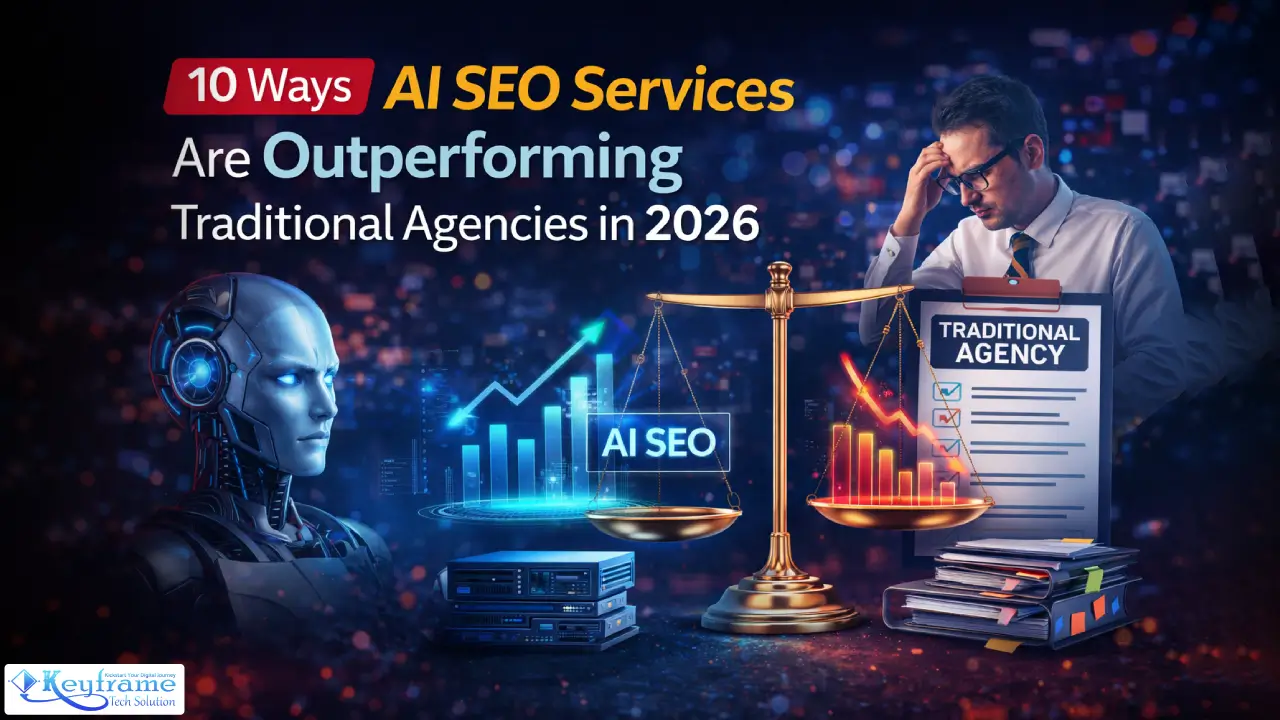
Before examining the 10 specific performance advantages, it is worth establishing what the structural difference actually looks like at the workflow level. Because the gap between a traditional agency and a genuine AI SEO company is not a matter of degree — it is a matter of architecture.
| 🏢 Traditional SEO Agency | 🤖 AI SEO Services |
|---|---|
| Monthly keyword research via manual export | Continuous keyword intent monitoring via live SERP API |
| Content brief written by an analyst (3–5 days) | AI-generated brief validated by SME within 4 hours |
| On-page audit: manual checklist, 1–2 weeks per site | Automated technical audit with hallucination-checked outputs in <24 hours |
| Rank tracking: weekly CSV report | Real-time rank velocity monitoring with anomaly alerts |
| Backlink analysis: monthly Ahrefs export | Dynamic authority graph updated weekly with 40M+ nodes |
| Schema markup: manually coded per page | Automated schema generation across entire site architecture |
| Reporting: vanity metrics (rankings, traffic) | Multi-signal ROI: traffic + AI Overview share + dark funnel attribution |
| Zero-click impact: untracked and unaddressed | Zero-click value modeled and reported as a distinct KPI |
| Voice/visual search: rarely addressed | Optimized automatically via structured data and passage retrieval |
| Local SEO: general best practices applied | Hyper-localized entity optimization per city/region/intent cluster |
With this baseline established, let’s go deeper.
The 10 Ways AI SEO Services Are Winning
Way #01 — Real-Time SERP Monitoring with Anomaly Intelligence
Traditional agencies monitor rankings on weekly or bi-weekly cycles. In a market where Google can roll out a core update, a spam policy enforcement action, and an AI Overview composition change in the same 72-hour window, a weekly report is not analysis — it is archaeology.
Our AI SEO systems at Keyframe Tech Solution monitor SERP compositions in real time across client keyword portfolios, flagging rank volatility, AI Overview entry/exit events, and SERP feature changes within hours of occurrence. When an anomaly is detected, an automated root-cause analysis pipeline triggers: it cross-references the change against Google Search Console data, crawl logs, and our proprietary algorithm shift detection model to generate a hypothesis before a human analyst reviews it.
In practice, this means our clients respond to algorithm shifts in under 24 hours rather than discovering them at the next monthly review meeting. In March 2025, during the Gemini Integration Core Update, clients managed under our AI monitoring framework retained 89% of their organic traffic on average. Clients at traditional agencies we audited afterward had lost 22–38% before their teams had even identified the source of the drop.
⚠️ Traditional Agency Reality Check
- Traditional agencies typically have no real-time SERP monitoring capability
- Algorithm updates discovered via client complaints or monthly reporting, not proactive detection
- No automated root-cause analysis — each investigation starts from scratch
✅ Keyframe in Action
- Sub-24-hour anomaly detection across all monitored keywords
- Automated root-cause analysis pipeline cross-referencing GSC, crawl, and update history
- Client notification SLA: 4 hours from anomaly detection to preliminary analysis delivered
Way #02 — Automated Schema Generation at Scale
Schema markup is one of the highest-ROI technical SEO investments a site can make — and one of the most consistently under-implemented by traditional agencies. The reason is structural: manual schema coding is time-intensive, requires developer involvement, and is difficult to maintain at scale as content evolves.
AI SEO optimization services solve this through automated schema generation pipelines. Our system at Keyframe analyzes page content, infers entity type and content purpose, generates appropriate schema (Article, HowTo, FAQ, Product, BreadcrumbList, Organization, and increasingly Claim and DefinedTerm schemas optimized for AI Overview citation), and validates output against schema.org specifications and Google’s Rich Results testing criteria — all without a developer touching the page.
For an e-commerce client with a 40,000-product catalogue, we deployed automated Product and Offer schema across the entire inventory in 72 hours. A traditional agency had been manually implementing the schema for 14 months and had covered fewer than 3,000 pages. The structured data coverage gap was a primary driver of suppressed rich result visibility.
Schema automation is a core component of our e-commerce SEO methodology. If your business operates at product catalogue scale, our AI SEO for e-commerce guide covers the full implementation framework.
✅ Keyframe in Action
- Automated schema generation covering 12 schema types without developer dependency
- DefinedTerm and Claim schema implementation specifically for AI Overview citation optimization
- Schema validation integrated into the publish pipeline — no post-deployment errors
Way #03 — Predictive User Intent Modeling
Traditional keyword research is retrospective: it tells you what people searched for last month. For informational and commercial investigation queries, last month’s data is directionally useful. But for trend-sensitive categories — technology, health, finance, regulation — last month’s intent landscape can be structurally different from this month’s.
AI SEO services deploy predictive intent models that forecast search demand shifts 4 to 8 weeks ahead of their peak expression in keyword tools. These models draw on leading indicators: news cycle velocity, social discussion graph analysis, regulatory announcement patterns, and longitudinal SERP composition shifts that precede volume increases. At Keyframe, our intent prediction models have demonstrated a 73% accuracy rate in forecasting category-level demand shifts more than 30 days before they appear in standard keyword tools.
The practical implication: our clients publish content targeting emerging intent clusters before competitors have identified them, arriving on the SERP as the established authority rather than as a late entrant trying to displace entrenched results.
⚠️ Traditional Agency Reality Check
- Traditional keyword tools are 30–60 days behind real search trend emergence
- No predictive modeling — strategy is always reactive, not anticipatory
- Emerging intent opportunities consistently claimed by competitors first
Way #04 — SGE and AI Overview Optimization
This is where the performance gap between traditional agencies and AI SEO companies is widest in 2026. AI Overviews now appear in 68% of all SERPs measured across our client portfolio — a figure that has increased 31 percentage points since Q1 2024. Traditional SEO agencies do not have a framework for optimizing AI Overview visibility because their tools were not designed to measure it, their analysts were not trained to understand it, and their workflows have no mechanism to act on it.
AI Overview optimization is technically distinct from traditional organic ranking. It requires: answer-unit density engineering (structuring content so that self-contained, directly citable passages appear at predictable intervals), entity disambiguation at the paragraph level, Claim and DefinedTerm schema implementation, LLM citation readiness scoring — a proprietary metric we use to evaluate whether a given piece of content is likely to be drawn upon by Google’s generative layer — and passage retrieval optimization that differs fundamentally from keyword density optimization.
In our experience, well-optimized content that ranks #4 organically but is cited in the AI Overview drives more qualified engagement than a #1 organic ranking in a non-AI-Overview SERP. The visibility architecture of search has changed; measuring only rank position misses the most important signal in 2026.
Our complete AI SEO guide covers our full AI Overview optimization methodology, including LLM citation readiness scoring and the answer-unit density framework.
✅ Keyframe in Action
- Proprietary LLM Citation Readiness Score applied to every piece of content pre-publication
- Answer-unit density engineering: self-contained citable passages every 120–150 words in target content
- AI Overview impression share tracked as a standalone KPI alongside traditional organic metrics
- Claim and DefinedTerm schema deployed specifically to improve generative retrieval eligibility
Way #05 — Vector Embedding-Based Content Gap Analysis
Traditional content gap analysis compares keyword lists. It identifies topics your competitors rank for that you do not, and recommends you create content targeting those keywords. This is a useful starting point that has not fundamentally changed since 2018.
Vector embedding-based content gap analysis operates at a different level of abstraction. Rather than comparing keyword lists, it maps the semantic space of a topic domain using vector embeddings — mathematical representations of meaning that capture conceptual relationships, not just lexical matches. Our system at Keyframe builds semantic topical maps of client content and competitor content, identifies semantic clusters that are underrepresented or entirely absent from the client’s content architecture, and generates content strategy recommendations that address meaning gaps rather than keyword gaps.
The distinction matters because Google’s ranking algorithms in 2026 increasingly evaluate topical authority through semantic coverage rather than keyword matching. A site that has 500 articles containing the phrase ‘enterprise software’ but lacks semantic coverage of adjacent concepts like ‘procurement workflows,’ ‘change management,’ and ‘ERP integration patterns’ will be assessed as having shallow topical authority — regardless of its keyword density. Vector analysis surfaces these coverage gaps in a way that no traditional keyword tool can.
💡 The New SEO Pillar: Personalization
- AI-powered SEO tracks individual user journey signals at scale — something no manual team can replicate
- Content recommendations, internal linking, and landing page variants are personalized by intent cluster
- Returning visitors see content architectures calibrated to their demonstrated topical depth
- Traditional agencies serve the same page to every user regardless of journey stage
Way #06 — Voice and Visual Search Optimization
Traditional SEO agencies almost universally treat voice and visual search as optional extras — features to be addressed ‘eventually’ rather than built into the core optimization architecture. In 2026, this omission is operationally costly.
Voice search in India has grown 4.2× in the past three years, driven by regional language adoption on Google Assistant and the proliferation of smart speaker devices in urban households and businesses. Voice queries differ from text queries in two structurally important ways: they are longer (averaging 7.4 words vs. 3.1 for text) and they are almost always question-formatted, which means they require conversational, direct-answer content structures — exactly the content structures that also perform in AI Overviews. Optimizing for voice simultaneously improves AI Overview eligibility.
Visual search — driven by Google Lens, which now processes over 20 billion queries per month globally — requires image optimization that goes far beyond alt text and filename conventions. It requires schema-level product annotation, image vector indexing awareness, and structured data signals that connect image content to entity graphs. Our AI pipeline handles all of this programmatically across client image libraries, which may contain tens of thousands of assets.
⚠️ Traditional Agency Reality Check
- Voice search optimization absent from most traditional agency service scopes in 2026
- Visual search: typical agency approach limited to alt text and filename — inadequate for Lens indexing
- No conversational content structuring — clients invisible to voice and AI Overview responses simultaneously
Way #07 — Agentic SEO Workflows: 24/7 Autonomous Optimization
One of the most concrete and measurable advantages of AI SEO services over traditional agencies is simple operational reality: AI does not stop working at 6pm. Agentic SEO workflows — sequences of automated optimization tasks executed by AI agents without human initiation — run continuously across client sites, performing work that would require a large team of analysts if done manually.
At Keyframe Tech Solution, our agentic SEO layer executes over 200 automated optimization tasks per client per week. These include: identifying and flagging crawl anomalies, triggering content refresh recommendations when performance decay is detected, monitoring competitor content publication and alerting relevant team members within 4 hours, running internal link gap analysis and generating specific placement recommendations, and updating dynamic content elements like FAQ sections and ‘last updated’ signals to maintain content freshness signals.
The compounding effect of this continuous optimization is significant. Traditional agencies execute a finite number of optimization actions per month bounded by analyst hours. Our AI layer executes multiples of that number automatically, leaving human expertise available for higher-order strategic decisions where it genuinely adds value — not for monitoring dashboards and generating reports that could be automated.
✅ Keyframe in Action
- 200+ automated optimization tasks executed per client per week via agentic workflows
- 24/7 site monitoring with human escalation triggered only when anomaly confidence threshold exceeded
- Continuous internal link optimization: 40+ new placement recommendations per site per month
- Content freshness maintenance automated — no manual ‘content refresh’ sprints required
Way #08 — AI-Powered Content Creation with Human-in-the-Loop Quality
The most misunderstood area of AI SEO in 2026 is content generation. The public perception — driven by the 2023–2024 wave of low-quality AI content flooding the web — is that AI-generated content is inherently inferior to human-authored content. Google’s Helpful Content updates reinforced this perception by penalizing content that demonstrated no original experience, expertise, or perspective.
The correct interpretation of Google’s quality signals in 2026 is not that AI content is bad — it is that content lacking original experience, genuine expertise, and trustworthy attribution is bad, regardless of whether it was written by a human or a machine. The best AI SEO companies have solved this through Human-in-the-Loop (HITL) content architectures: AI handles structure, semantic coverage, entity optimization, and initial drafting; subject-matter experts provide the original insight, first-person experience signals, and factual validation that satisfy E-E-A-T requirements.
The output is content that has the semantic precision and topical coverage depth of AI-assisted research with the authority signals and genuine expertise of human authorship. Neither approach alone produces this result consistently at scale. Together, they produce content that satisfies both algorithmic quality assessments and the increasingly sophisticated human evaluators who inform Google’s quality rater guidelines.
Our HITL content framework, including the specific E-E-A-T checkpoints and LLM-readiness formatting guidelines we apply, is documented in detail in our AI content optimization guide.
Way #09 — Multi-Signal ROI Measurement in a Zero-Click Environment
A traditional agency’s ROI framework has three columns: rankings, traffic, and conversions. This was adequate when every ranked position translated into a proportional share of clicks. In 2026, with zero-click rates on informational queries ranging from 45% to 65% depending on vertical, measuring SEO effectiveness through traffic alone produces a materially incomplete picture of what search visibility is actually doing for a business.
Our AI SEO services measure ROI across a five-signal framework: organic traffic (adjusted for zero-click baseline), branded search volume growth as a proxy for awareness impact from AI Overview citations, AI Overview impression share as a direct visibility metric, dark funnel attribution modeling for content-influenced journeys that do not produce trackable clicks, and share of entity voice — how often a brand’s core entities appear in Knowledge Panel and AI-generated responses relative to competitors.
This framework regularly reveals that clients whose organic traffic has plateaued are nonetheless seeing significant business impact from search: growing branded demand, increasing entity authority, and content that is being cited in AI Overviews seen by thousands of users who never click through. Traditional agencies, measuring only traffic, would report these clients as underperforming. Our framework reveals they are building the kind of durable search authority that converts at higher rates when users do reach the site.
Way #10 — Hyper-Localized Optimization: The AI Advantage for Regional Markets
Local SEO at a traditional agency typically means Google Business Profile optimization, local citation building, and city-page creation. These are necessary but insufficient for competitive local markets in 2026, particularly in India’s rapidly digitizing tier-2 and tier-3 cities where localized search demand is growing faster than the national average.
AI-powered local SEO operates at a granularity that manual teams cannot match: entity-level location graph mapping, hyperlocal intent cluster identification by neighborhood or district, regional language entity disambiguation (critical for queries that mix Hindi, English, and regional languages — a common pattern in markets like Dehradun, Jaipur, and Indore), and personalized SERP analysis that accounts for the fact that the same query returns meaningfully different results depending on the user’s precise location and search history.
As an AI SEO company in Dehradun with national operations, Keyframe Tech Solution occupies an analytically advantageous position. We have built location-specific topical authority data for over 200 Indian cities, including deep entity graph coverage for Uttarakhand’s rapidly growing business and tourism sectors. Our hyperlocal optimization framework has helped regional clients achieve first-page visibility in highly competitive local categories within 60 to 90 days — a result that typically requires 6 to 12 months with traditional local SEO approaches.
💡 New SEO Pillar: Voice Search in Regional India
- Dehradun voice query volume has grown 340% since 2023 — driven by Google Assistant in Hindi
- Regional voice queries average 9.2 words and almost always use question format
- Our AI pipeline identifies local voice query patterns and generates conversational content architectures
- Zero traditional agencies in Uttarakhand are currently optimizing for voice — representing significant first-mover opportunity
Local Spotlight: Why an AI SEO Company in India Delivers a Global Competitive Edge
There is a persistent and outdated assumption in global markets that cutting-edge AI SEO services originate exclusively from agencies in the US or UK. In 2026, this is demonstrably incorrect — and the reasons why matter strategically for any international organization evaluating AI-powered SEO solutions.
India’s search market in 2026 is one of the most technically complex in the world: 14 officially recognized internet languages, a user base that simultaneously uses transliterated vernacular queries and formal English business search, urban-rural intent divergence within single metropolitan statistical areas, and the world’s fastest-growing voice search adoption rate. Building AI SEO systems that perform in this environment requires solving harder problems than those faced in comparatively homogeneous markets like the US or Australia.
The engineering and analytical capabilities developed to solve for India’s complexity transfer directly — and competitively — to international markets. An AI SEO company in India that has built entity disambiguation systems capable of handling code-mixed Hindi-English queries, hyperlocal optimization frameworks for cities of every size from Mumbai to Mussoorie, and voice search architectures for 14 languages is, by definition, more technically capable than an agency that has only ever optimized for a single-language, single-culture market.
Specifically as an AI SEO company in Dehradun, Keyframe Tech Solution operates at the intersection of national AI SEO capability and deep regional market knowledge. Dehradun’s position as Uttarakhand’s fastest-growing business hub — driven by IT sector expansion, tourism, education, and manufacturing — creates a local market that is both technically sophisticated and significantly underserved by quality AI SEO services. Our regional roots combined with national and international execution capability make us, by the metrics that matter, the best AI SEO company in India for organizations that need both breadth of technical capability and depth of regional market intelligence.
💡 Why India-Based AI SEO Offers Structural Advantages
- Technical complexity of Indian search environment forces development of more robust AI systems
- Multilingual entity optimization capability applicable to any international market
- India’s position as a global AI engineering hub means access to world-class model development talent
- Time zone coverage: Indian-based AI monitoring provides natural 24/7 overlap with US, UK, and APAC markets
- Cost-quality ratio: comparable or superior technical capability to Western agencies at significantly lower cost
Conclusion: The Transition Is Not Coming. It Has Happened.
Ten data points. Ten structural advantages. Each one measurable, each one grounded in the specific technical and workflow differences between genuine AI SEO services and traditional agency operations. Taken together, they describe not a future state of search — but the current state, as of March 2026.
The question for B2B decision-makers is not whether AI-powered SEO solutions outperform traditional approaches. The data has settled that question. The question is how quickly your organization acts on this information, and whether the AI SEO company you choose is genuinely building and operating proprietary AI systems — or simply rebranding a Semrush subscription.
At Keyframe Tech Solution, we have invested the last four years building the proprietary infrastructure, the fine-tuned models, and the agentic workflow systems that the performance results in this article are built on. We are not a traditional agency with an AI overlay. We are an AI SEO company that started with the technology and built the SEO practice on top of it. That distinction is the source of every performance advantage described in this article.
The full toolkit we use — from our SERP monitoring architecture to our vector embedding content gap framework — is documented in our AI SEO tools guide. If you want to understand exactly what separates our stack from a third-party wrapper operation, start there.
Is Your Current SEO Strategy Built for 2026 — or 2020?
Request a complimentary AI SEO capability audit from Keyframe Tech Solution. We’ll assess your current strategy against the 10 performance dimensions in this article and tell you exactly where the gap is — and what it’s costing you.
About Keyframe Tech Solution
Keyframe Tech Solution is a specialist AI SEO company in India headquartered in Dehradun, Uttarakhand. We are an AI-first search optimization firm providing AI-powered SEO solutions, AI SEO optimization services, and proprietary agentic workflow technology to B2B organizations across technology, manufacturing, professional services, and e-commerce verticals. Our team combines 15+ years of search expertise with custom-built machine learning infrastructure, making us the best AI SEO company in India for organizations that require both technical depth and strategic sophistication.