

- Oct, Sat, 2026

Introduction: The Shift to Hyper-Local Real Estate Search
Real estate transactions start online, but real estate decisions are hyper-local. Buyers and sellers rarely search for a generic “real estate agency.” They search for the person who knows a specific subdivision, school zone, postal code, or high-rise: “listing agent in Riverside Heights,” “property management company near me,” “who sells condos downtown.”
That behavior creates a problem for brokerages running broad, city-wide SEO. You may rank for a competitive head term and still be invisible in the three or four neighborhoods where you actually want to win listings. In those pockets, a smaller local competitor with a sharper Google Business Profile (GBP), or a national aggregator with a bigger budget, captures the call, the direction request, and the valuation inquiry.
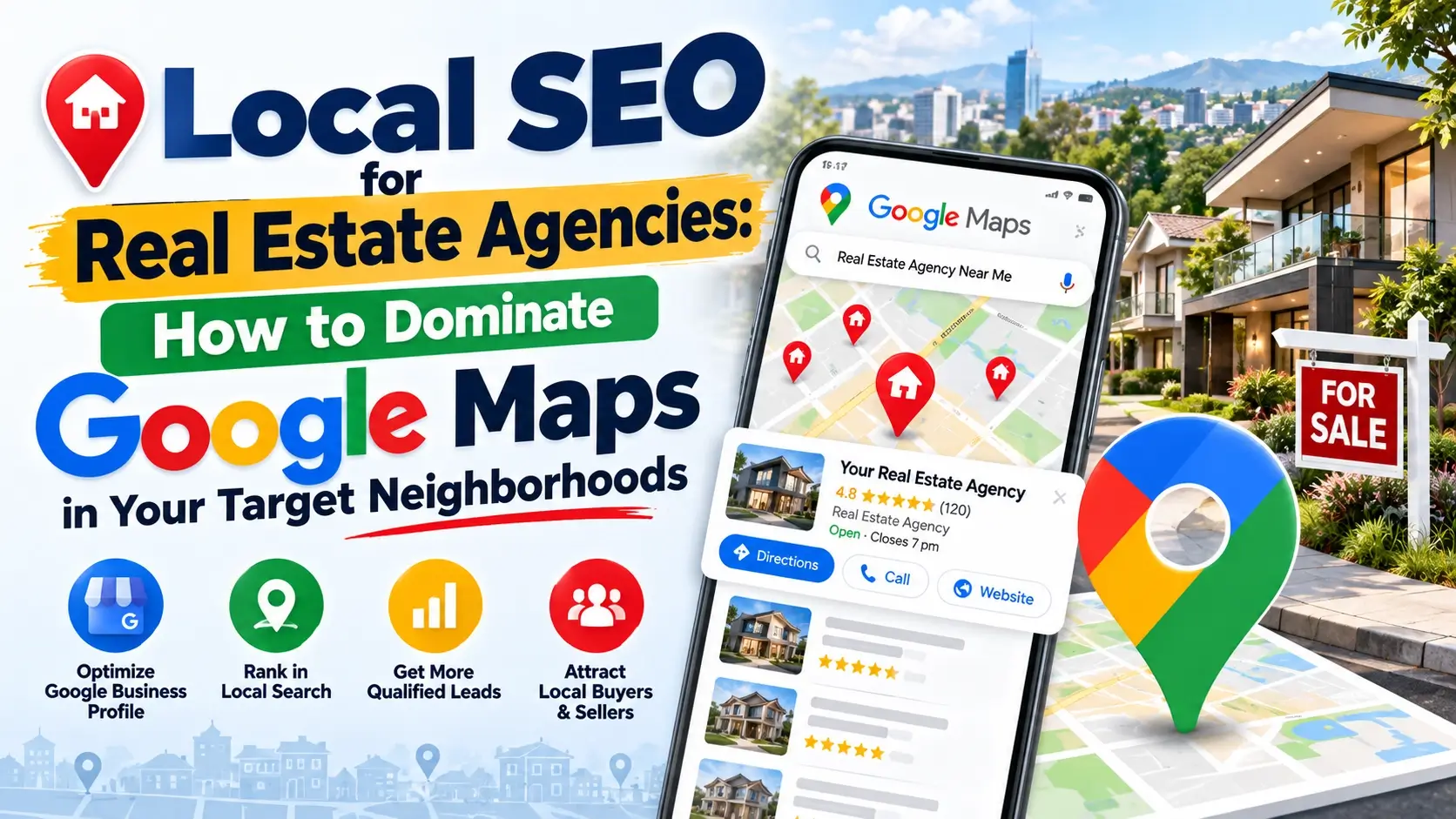
The Google Maps Local Pack is where that fight is won or lost. It sits above organic results, it is built for “near me” intent, and the businesses in its top three spots collect a disproportionate share of local engagement. For brokerages, one seller lead can be worth thousands in commission, so a handful of Map Pack positions can carry real revenue.
This guide walks through four strategies for building neighborhood-level dominance, and the technical traps that quietly undo most brokerages’ efforts. If you want professional support, our real estate SEO services are built around exactly this approach.
Strategy 1: Neighborhood-Specific GBP and Keyword Targeting
The foundation of Map Pack visibility is telling Google precisely what you are and where you serve. Most real estate profiles get both wrong.
Choose Your Categories Deliberately
Your primary category is among the strongest local ranking signals, and it should match your core revenue line, not the broadest label available.
- Real Estate Agency: the default for a brokerage serving buyers and sellers
- Real Estate Agent: best for an individual practitioner’s own profile
- Property Management Company: for rental and HOA management arms
- Commercial Real Estate Agency: for commercial-focused brokerages
Use secondary categories to capture adjacent services (for example, Real Estate Consultant, Real Estate Rental Agency, or Apartment Rental Agency where they genuinely apply). Do not add categories that don’t reflect real services; relevance matters, and irrelevant categories dilute the signal.
Build Service Areas Around Real Neighborhoods
If you serve clients at their properties rather than from a storefront, the service area setting tells Google where you operate. Google limits how many areas you can list, so prioritize the neighborhoods, cities, or postal codes that generate (or could generate) your best listings, not every area you’d like to cover eventually.
A realistic approach:
- Start with the 5 to 10 neighborhoods where you hold listing history or local expertise
- Add adjacent areas only where you can back them up with content and reviews
- Keep area names consistent with how locals and Google actually refer to them
Write a Business Description That Reads Like Expertise
Your description should sound like a local specialist, not a keyword list. Weave in neighborhood names, landmarks, and regional terms naturally:
- Weak: “Best real estate agent Austin real estate homes for sale Austin TX.”
- Stronger: “Helping buyers and sellers across Zilker, Barton Hills, and South Lamar, from bungalows near Barton Springs to new-build townhomes along South Congress.”
The second version is more useful to a human and gives Google richer geographic context. Never put neighborhood names or keywords into your business name; that is a fast route to suspension.
Pro Tip for Brokerages: Address Compliance
Google requires a real, staffed, customer-accessible location for a storefront-style listing. Virtual offices, co-working addresses you don’t staff, and PO boxes are common triggers for suspension. If your brokerage opens a satellite office to “cover” a new neighborhood without actually staffing it during posted hours, you risk a suspended profile and the loss of reviews and rankings that come with it. Use service areas for coverage; use a real address only for a genuinely operating office.
For a complete line-by-line audit of these fundamentals, use our Google Business Profile Optimization Checklist.
Strategy 2: Managing Main Office Profiles vs. Individual Agent Listings
This is the question brokerages ask most often: should individual agents have their own Google Business Profile, or should everything run through the brokerage’s main listing?
The honest answer: it depends, and the wrong setup can hurt both.
What Google’s Guidelines Generally Allow
Google’s guidelines treat an individual “practitioner” (a public-facing professional such as an agent) differently from an organization. In general terms:
- An individual agent may qualify for their own profile if they are a public-facing practitioner who deals directly with customers
- Each practitioner should have one profile, and the brokerage should have one profile for the organization
- Duplicate listings for the same entity violate guidelines and can cause suppression or suspension
- Ineligible or misleading listings (shared fake addresses, agents listed at offices they don’t work from) are a common source of removals
Guidelines change. Always verify against Google’s current Business Profile policies before restructuring a multi-agent setup.
A Practical Decision Framework
| Situation | Recommended approach |
|---|---|
| Small brokerage, shared brand, few agents | Strong main office profile; individual profiles only for top-producing, public-facing agents |
| Large brokerage, agents with personal brands | Main office profile for the brand; selective, compliant agent profiles with clear naming rules |
| Team within a brokerage | One team profile only if it meets eligibility; avoid duplicating each member’s listing |
| Commercial or property management arm | Separate profile only if it operates as a distinct, eligible business |
Co-Branding Without Cannibalizing
The goal is for agent profiles to reinforce the main office, not compete with it.
- Use a consistent naming convention that follows Google’s rules (the agent’s real name, not keyword-padded, with brokerage branding handled in the description and website)
- Link each agent profile to their dedicated agent page on the brokerage website, and the main office profile to the homepage or office page
- Keep logos, brand language, and photography consistent across every listing
- Maintain accurate NAP (name, address, phone) data everywhere, with distinct, trackable numbers where appropriate
- Cross-reference agent and brokerage on the website so Google can see the relationship clearly
Pro Tip for Brokerages: Handling Agent Departures
This is the trap most brokerages learn the hard way. When an agent leaves, their profile (and the reviews on it) may stay owned by them, or stay live under your brand. Set a written policy before onboarding: who owns the profile, who is the verified owner, who holds manager access, and what happens on departure. Remove the brokerage’s branding and website link from a departed agent’s listing, or mark the profile appropriately, and never leave outdated agents attached to your main profile. Unmanaged departures create stale listings, misdirected leads, and avoidable brand-confusion complaints.
For brokerages operating several offices, the same ownership and consistency principles apply at scale, and our Google Business Profile optimization services cover multi-location governance.
Strategy 3: Transforming Your GBP Into a Virtual Showroom
Home buyers are visual by nature. Your profile should work like a storefront window, not a static directory entry.
Use Products and Services to Showcase What You Sell
GBP’s Services and Products sections are underused by most agencies. Use them to present:
- Service lines: buyer representation, seller representation, relocation, investment advisory, and property management packages
- Featured properties and signature listings: keep descriptions accurate, current, and consistent with your website and MLS data
- Specialty niches: luxury estates, first-time buyer programs, downsizing, new construction, or senior-living transitions
Keep information fresh. A profile still promoting a home that sold six months ago erodes trust faster than an empty section.
Win on Visual Engagement
- High-resolution interior and exterior photography that reflects the neighborhoods you serve
- Office and team photos that make you feel like real, local people
- Short-form video updates: a 30-second neighborhood walkthrough, a new-listing teaser, or a market snapshot
- Neighborhood virtual tours linked from your profile and website
On “geotagging”: embedding location data in image files is a common recommendation, but its direct ranking impact is unproven. Don’t rely on it. What reliably helps is authentic, recent photos taken in the places you serve, descriptive file names, and a steady upload cadence.
Use Google Posts to keep the profile active with open houses, price changes, market updates, and new listings, each referencing the specific neighborhood.
Strategy 4: Neighborhood-Level Client Testimonials and Social Proof
A wall of generic five-star reviews (“Great agent, highly recommend!”) builds some trust, but it does little to prove local relevance.
Why Specific Reviews Work Harder
Reviews that naturally mention a neighborhood, a property type, and the agent’s name give both prospects and Google more information:
- “Sold our condo in Downtown within two weeks” tells a prospect you’re proven in that market
- Mentioning the agent supports individual profile credibility
- Descriptive language around services and locations reinforces what you do and where, a relevance signal for local search
Reviews are also among the factors Google has said contribute to local prominence, and they strongly influence whether a searcher picks you once you appear.
How to Earn Better Reviews (Without Scripting Them)
- Ask at the right moment: right after closing, when satisfaction is highest
- Make it easy: send a direct review link by text or email, and consider a QR code at closing
- Prompt with questions, not scripts: “Which neighborhood were you buying in? What stood out about working with us?” Never write the review for a client or offer incentives, which Google prohibits
- Reply to every review, naming the neighborhood or service where it’s natural and authentic
- Handle negatives professionally: respond promptly, stay factual, and take the details offline
Review velocity matters as much as total volume. A steady flow of recent reviews outperforms a burst followed by months of silence.
Conclusion: Build a Moat in the Neighborhoods That Matter
National portals and aggregators will always outspend a local brokerage on broad terms. They can’t easily match genuine neighborhood expertise expressed through a well-managed, compliant, review-rich Google Business Profile.
Dominating target neighborhoods on Google Maps builds a long-term moat. Each accurate category, each properly structured agent listing, each neighborhood-specific review, and each fresh photo compounds into a position competitors find hard to dislodge.
The brokerages that win hyper-local search are not necessarily the biggest. They are the most deliberate.
Ready to Dominate Your Target Housing Markets?
Ready to dominate the Google Map Pack in your target housing markets? Contact Keyframe Tech Solutions today for a custom Local SEO & Google Business Profile Strategy built for real estate brokerages.
Keyframe Tech Solutions is a digital agency specializing in SEO, Google Business Profile management, and hyper-local ranking strategies for real estate brokerages, property managers, and agents.