
- Aug, Sat, 2026

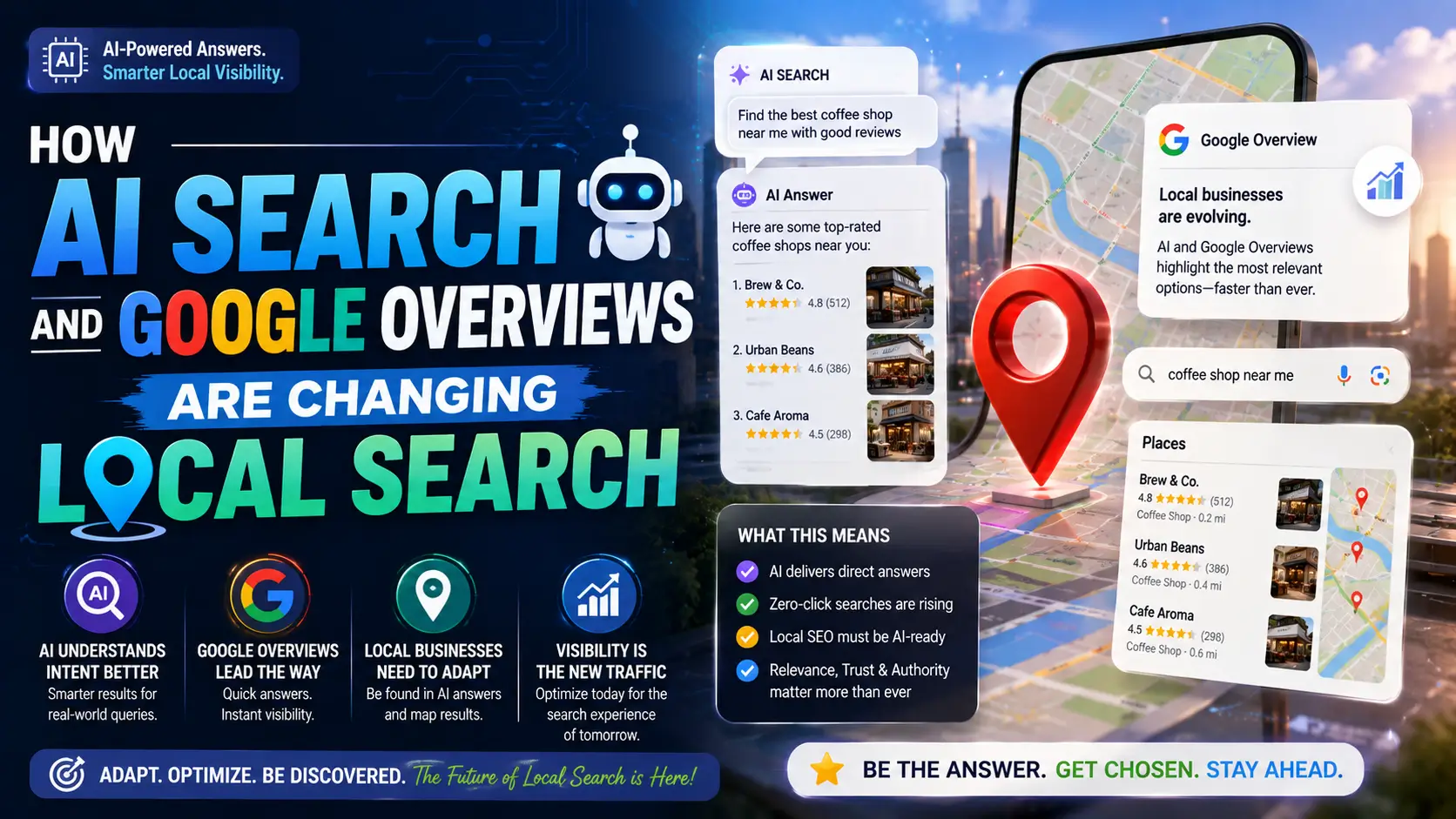
Zero-click local search is no longer a theory; it is the default state of the SERP. The “Ten Blue Links” model that local operators optimized for over the past two decades is now sharing real estate, and often losing it entirely, to large language model summaries positioned above the fold. AI Overviews (AIO) and the broader shift toward conversational, retrieval-based search have compressed the map pack, the organic results, and the paid ads into a smaller and smaller slice of screen space, particularly on mobile.
For SMB owners and multi-location franchise managers, this is not a marginal ranking fluctuation. It is a structural change in how discovery works. A business can hold position one on a traditional blue-link result and still see traffic evaporate if it is never surfaced inside the AI-generated answer sitting above it. This is why AI SEO and AI Services have moved from buzzwords to operational necessities: the criteria for visibility have changed from “rank well” to “get cited, get referenced, and get resolved as the answer.” The businesses adapting fastest are treating generative visibility as a distinct discipline, not an extension of the old playbook.
The Architecture of Change: What Happens to Local Queries?
Traditional search ran on keyword string matching an index of pages scored against the literal terms a user typed. Google’s current architecture works differently. It processes queries as semantic entities, resolving intent through conversational embeddings rather than exact-match keywords. Retrieval-Augmented Generation (RAG) sits at the core of this shift: instead of simply ranking documents, the system retrieves relevant, trustworthy source material and synthesizes it into a direct answer, citing (or not citing) the sources it draws from.
This has produced a clear split in how local intent is handled:
Informational and “near me” cost-and-comparison queries (“how much does a plumber cost in my area,” “best time to visit a local orthodontist”) are now resolved by AI Overviews at extremely high rates. Independent studies tracking local query behavior in 2026 have found AI Overviews triggering on the large majority of informational local searches, while traditional map-pack local results appear on a smaller share of the same query set.
Transactional, bottom-funnel queries (“book a plumber near me,” “[business name] hours”) continue to pull heavily from cross-referenced map directories and Google Business Profile data, because the user’s intent is action, not explanation.
The practical consequence is that a business’s website content now has to do two jobs simultaneously: rank in traditional results and supply fact-dense, extractable answers that RAG systems can retrieve and cite. This dual mandate is exactly why comprehensive SEO services have expanded beyond backlinks and meta tags into structured, machine-readable content strategy. Businesses that treat their site as a reference document for both humans and retrieval systems are the ones showing up inside the answer box, not just below it.
There is also a source-diversity dimension operators tend to overlook. AI Overviews don’t draw exclusively from a business’s own website; they pull from third-party review platforms, directories, and forums as well. Studies tracking local AI citations have found that a substantial share of citations point to third-party publishers like Yelp, Thumbtack, and industry directories rather than the business’s own domain. That means an entity-level strategy, one that manages presence across the entire ecosystem a retrieval system might draw from, outperforms a narrow, website-only approach.
The Hard Data: Why Traditional Local CTR is Dropping
The numbers here are no longer speculative; they are well-documented across multiple independent studies conducted through 2025 and into 2026.
The CTR decline is real and accelerating. Ahrefs’ original study of 300,000 keywords found that the presence of an AI Overview correlated with a 34.5% average drop in click-through rate for top-ranking pages. A follow-up using the same methodology, published in early 2026, found that the decline had widened to 58%, meaning that for every 100 clicks a position-one result would have earned in the pre-AIO era, roughly 58 of them are now absorbed by Google’s own answer box instead. Pew Research’s independent behavioral tracking found a similar directional pattern: an 8% click rate on searches where an AI Overview appeared, versus 15% where it didn’t a relative decline of nearly half. Seer Interactive’s longer time-series study, spanning over 3,000 informational queries, documented organic CTR falling from 1.76% to as low as 0.61% at the trough, before a partial rebound in early 2026.
Citation status is now the deciding variable. The data consistently shows that being cited inside the AI Overview meaningfully changes outcomes. Multiple 2026 studies, including Seer Interactive’s, report that brands cited within an AI Overview see roughly a 35% higher organic CTR than uncited competitors ranking on the same query while non-cited pages absorb the full brunt of the traffic decline. This is the essence of Generative Engine Optimization (GEO): the target metric is no longer rank position alone, it’s citability whether your content is structured, sourced, and factually dense enough for the retrieval layer to select it as source material.
AI Overviews now out-rank the map pack for visibility. A Whitespark study found AI Overviews now appear on roughly 68% of local searches, compared to just 39% for the traditional local pack on the same query set. That is a direct reversal of the old hierarchy, where the map pack was the default local SERP feature. For a local operator, this means Google Business Profile optimization alone is no longer sufficient the AI layer is increasingly the first thing a searcher sees.
The competitive pressure this creates is significant. Businesses relying on legacy tactics are watching qualified traffic route around them entirely, which is precisely why securing the best SEO services available services that understand both classic ranking factors and generative citation mechanics has become a defensive necessity rather than a growth luxury.
The Survival Blueprint: Intercepting Clicks via Map & Entity Matching
Winning visibility in this environment requires a specific, technical execution plan. Four elements matter most:
- Entity Validation. Google’s AI systems cross-reference Name, Address, and Phone number (NAP) data across your website, third-party aggregators (Yelp, Yellow Pages, industry directories), and mapping platforms before trusting your business as a citable entity. Inconsistent NAP data even a suite number mismatch introduces ambiguity that retrieval systems tend to resolve by simply excluding the source. Full entity consistency across every platform where your business is listed is now a prerequisite, not a nice-to-have.
- Schema Graphing. Clean, comprehensive LocalBusiness structured data (schema.org markup) feeds Google’s semantic indexers directly, giving the AI system machine-readable facts about your hours, services, service area, pricing range, and reviews rather than forcing it to infer these details from unstructured page copy. Businesses that pair accurate schema with page content that actually substantiates the markup are seeing measurably better inclusion rates in AI-generated answers.
- Review Velocity and Profile Depth. Google’s AI overwhelmingly draws local recommendations from verified profile data and review sentiment. This is why a properly executed GMB optimization service one that manages review acquisition, Q&A accuracy, post cadence, and category precision now sits at the foundation of AI search retrieval, not as a side task bolted onto a broader campaign. A thin or stale Google Business Profile gets filled in by AI inference, often inaccurately, which actively damages how your business is represented.
- Fact-Dense, Locally-Specific Content. Location pages need real cost ranges, real service area detail, and genuine answers to the questions local customers actually ask not templated city-swap pages. This is the content layer that a dedicated local SEO services program builds systematically, and it’s the layer AI systems reward most directly with citations.
Regional markets are shifting accordingly. As competitive density increases in mid-sized cities, the demand for specialized, locally-fluent execution for example, targeted SEO services in Dehradun, reflects a broader pattern: generic, one-size-fits-all optimization is losing ground to operators who understand both the local market and the mechanics of AI retrieval simultaneously.
Conclusion: Dominating the Future with Keyframe Tech Solutions
AI is not destroying local search traffic; it is filtering it. The searchers who make it past an AI Overview and still click through are, by definition, more informed and closer to a purchase decision than the average searcher of five years ago. The businesses losing ground are not losing to AI; they are losing to competitors who have already restructured their entity data, their schema, and their content for a retrieval-first search environment.
Keyframe Tech Solutions has built the engineering matrices, entity validation frameworks, schema architecture, GEO-aligned content systems, and profile optimization protocols required to compete and win inside this new architecture. Local visibility in 2026 is not won by chance; it’s won by execution precision. Visit Keyframe Tech Solutions today to claim a custom AI-readiness and local visibility evaluation, and find out exactly where your business stands before your competitors close the gap.