

- Aug, Mon, 2026

Introduction
A business can have a polished website and still lose most of its local customers before anyone clicks a single link. Search visibility now starts at the top of the results page, inside a block of three business listings tied to a map. This is the Map Pack, and it sits above the standard organic results for almost every “near me” or service plus city search.
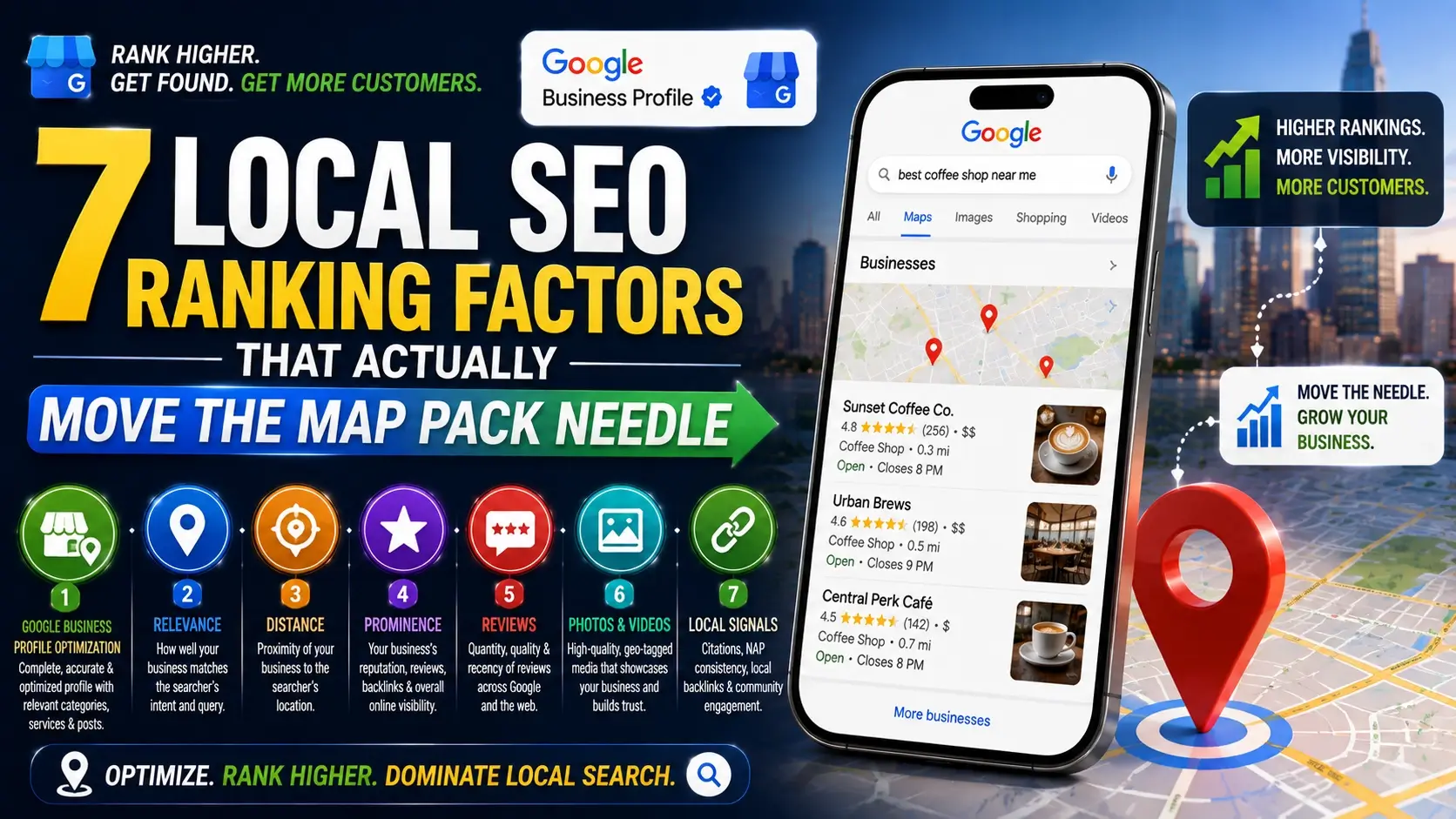
Ranking in the Map Pack is not about doing everything at once. Most agencies pad their checklists with dozens of minor tasks while ignoring the seven factors that carry real weight. This article breaks down those seven factors in plain terms, based on what actually correlates with ranking movement, not theory.
If you want a full walkthrough of setting up your listing correctly from scratch, our Google Business Profile optimization checklist covers the setup process step by step. What follows here focuses on the ranking mechanics behind that setup.
Factor 1 Google Business Profile Primary Category
The primary category on a Google Business Profile is the single strongest signal for determining which searches a business shows up for. Google uses this field to decide the intent match between a searcher’s query and a listing, before it even looks at reviews or distance.
A dentist listed under “Medical Clinic” instead of “Dentist” will lose visibility for dental searches even with a perfect website. The same applies to a real estate agent filed under “Real Estate Agency” when “Real Estate Consultant” or “Real Estate Agent” fits the actual service offered.
Business owners should audit their primary category every few months. Google periodically adds new, more specific categories, and switching to a narrower, more accurate one often produces a visibility increase within weeks. Secondary categories help too, but the primary category does most of the work.
Factor 2 Physical Proximity to the Searcher
Distance is a ranking factor Google controls, not the business. When someone searches for a service, Google weighs how close each candidate business is to the searcher’s location, alongside relevance and prominence.
This creates a hard constraint. A business three miles from a searcher will often outrank a stronger, better optimized competitor that sits eight miles away, simply because it is closer at the moment of the search.
Businesses cannot move their address to chase every searcher, but they can manage this constraint in two ways. First, service area businesses should list every neighborhood or city they genuinely serve in their profile settings, rather than only the city of their main office. Second, for businesses with multiple locations, each branch needs its own fully built profile rather than one shared listing. Trying to rank a single location for an entire metro area works against how Google’s proximity model functions.
Factor 3 Keyword Relevance in the Business Title
The business name field carries measurable ranking weight, which is why so many companies stuff extra keywords into it, such as “Smith Dental, Best Dentist in Austin.” This tactic works in the short term because Google’s algorithm does register the keyword match.
It also violates Google’s Business Profile guidelines, which require the name field to reflect the business’s real world name only. Google has become more aggressive about detecting and suspending profiles that violate this rule, and a suspension erases all accumulated reviews and ranking history overnight.
The safer approach is to let the business’s legitimate name carry natural keyword relevance where it already exists, and to build topical relevance through the category field, the services list, and the website itself rather than through name manipulation. A suspended profile costs far more than a modest ranking gain is worth.
Factor 4 Review Velocity and Sentiment
Review count matters, but velocity matters more. Google’s algorithm appears to reward a steady, ongoing stream of new reviews over time rather than a single spike of fifty reviews collected in one week. A sudden burst also raises spam detection flags, which can result in reviews being filtered out or the profile being flagged for manual review.
Sentiment plays alongside velocity. Star rating alone is a blunt signal, but Google’s systems also parse the text of reviews for keywords related to service quality, specific offerings, and location context. A review that mentions “fast appointment booking” or “great with kids” for a dental practice reinforces relevance signals beyond the star rating itself.
The practical takeaway is to build review collection into a regular business process, asking every satisfied customer at the point of service, rather than running occasional review campaigns. Consistency beats intensity here.
Factor 5 High Quality Local Citations
A citation is any online mention of a business’s name, address, and phone number, commonly referred to as NAP data. Many local SEO providers sell citation packages that submit a business to hundreds of low authority directories, most of which contribute little to ranking.
What actually matters is consistency across a small number of high authority platforms, including the major data aggregators, well known industry directories, and the Google Business Profile itself. If a business’s phone number is listed one way on its website and a different way on Yelp or an aggregator feed, that inconsistency creates confusion for Google’s matching systems and can suppress ranking confidence.
An audit of existing citations, followed by correction of any mismatched NAP data on the top twenty to thirty relevant platforms, produces better results than mass submission to hundreds of directories that carry little authority.
Factor 6 On Page Location Signals
A website’s landing pages need to reinforce the same local relevance that the Business Profile establishes. This means more than dropping a city name into a page title. Effective location pages include the full service area, embedded maps, locally relevant content such as neighborhood references or regional terminology, and schema markup that explicitly declares the business address and service area to search engines.
Businesses serving multiple cities or regions should build a dedicated page for each major service area rather than trying to rank one generic page for every location. A plumbing company serving five towns needs five location specific pages, each with unique content addressing that specific area, not five near identical pages with the city name swapped out.
For businesses researching a full local SEO strategy across a wider market, our guide to local SEO services in USA breaks down how on page and off page signals work together at a broader level.
Factor 7 Behavioral Signals
Google tracks how users interact with a Business Profile after it appears in search results. Clicks to call, requests for driving directions, clicks through to the website, and time spent viewing the listing all feed back into the ranking system as engagement data.
A listing that consistently earns clicks to call and direction requests signals to Google that real users find it relevant and useful, which reinforces its position for similar future searches. This creates a compounding effect, where profiles that already rank well tend to receive more engagement, which helps them stay ranked well.
Businesses can influence this indirectly by keeping their profile information complete and current. Listings with accurate hours, updated photos, a filled-out services section, and regular Google Posts activity give searchers more reason to interact with the listing directly, rather than scrolling past it.
Conclusion
None of these seven factors work in isolation. A perfectly chosen category means little if reviews are inconsistent, and strong citations cannot offset a business name that violates Google’s guidelines. Sustained ranking in the Map Pack comes from treating category selection, proximity management, honest naming, review consistency, citation accuracy, on page location signals, and user engagement as one connected system.
For most business owners, the realistic path forward is prioritization. Start with the primary category and NAP consistency, since both are quick to audit and correct. Then move into review velocity and on page location signals, which take longer to build but compound over months.
Businesses that want a structured, ongoing process rather than a one time fix often work with a dedicated SEO service provider to manage these factors continuously, since Google’s local algorithm shifts often enough that a single setup pass rarely holds up for more than a few months. Our team at Keyframe Tech Solution provides GMB optimization services and full local SEO services built around these exact ranking factors, for businesses that want this handled by a GMB optimization company rather than managed piecemeal in house. You can see our full approach to Google My Business optimization services and how we apply this GMB optimization checklist for clients across different industries.