

- Jul, Mon, 2026

Search is not limited anymore to mere keywords. The impact of AI on the interpretation of intent, context, and quality of content by search engines requires businesses to look for a different approach to SEO. McKinsey & Company reports that generative AI can deliver trillions of dollars of value for industries by revolutionizing knowledge and digital operations work, which includes marketing and search.
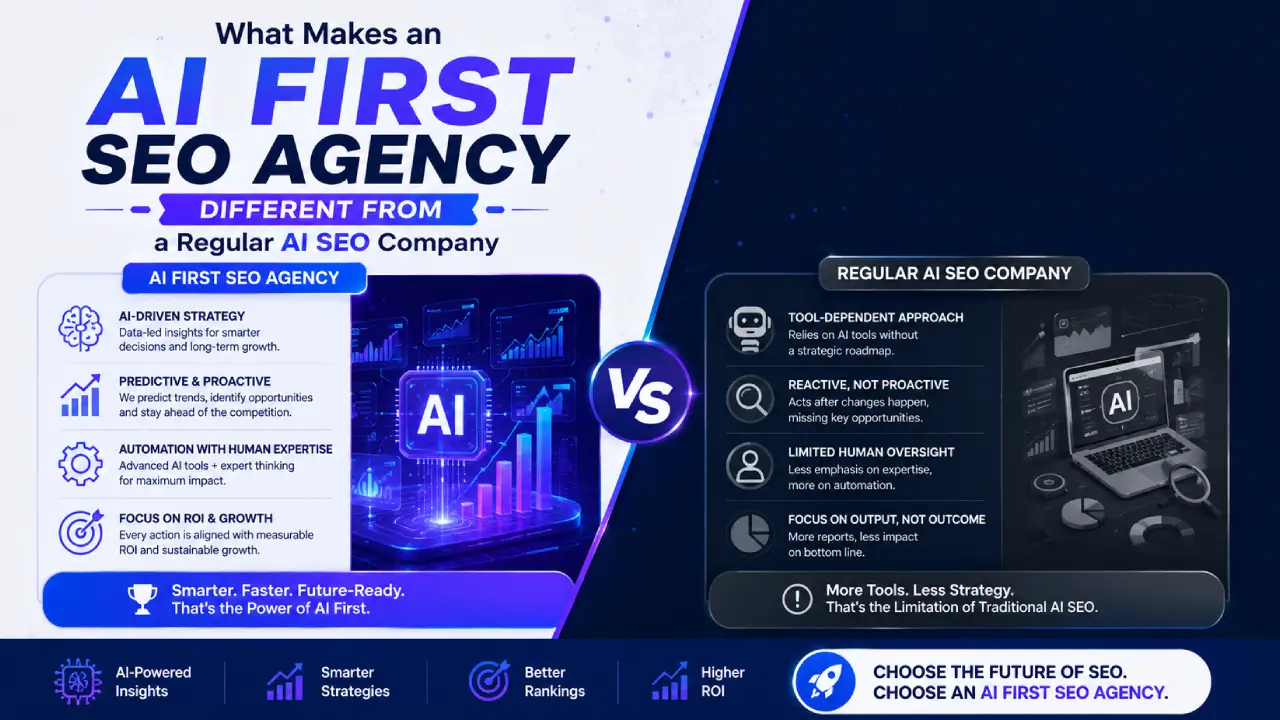
These changes have triggered the emergence of two fundamentally different service models – AI SEO companies, which apply artificial intelligence to enhance the existing SEO services, and AI-first SEO agencies, which construct their whole SEO strategy based on artificial intelligence. Both types of companies leverage cutting-edge technologies, but their workflow, decision making and optimization potential are fundamentally different.
Understanding AI in Modern SEO
Role of AI in Search Evolution
Search engines no longer only look for keywords and phrases to display relevant results. With AI, search engines are able to recognize user intent and context as well as determine the quality of content, which is why sites with relevant and experience-based information get priority today.
Shift From Manual SEO to AI-Assisted SEO
Previously, SEO required extensive manual research and audit, along with routine optimization tasks. Now, with AI, an SEO services provider can work with huge amounts of data much faster and make quicker decisions.
Impact of Machine Learning on Rankings and Visibility
Machine learning makes it possible to adjust ranking algorithms and factors depending on the behavior of users and the content’s relevancy. The websites that constantly provide relevant and high-quality content have a chance of better visibility.
What Is an AI First SEO Agency
An AI-first SEO agency places artificial intelligence at the center of its SEO process. Rather than using AI to help the conventional processes, it makes use of AI to perform the analysis, strategy making, implementation, and optimization while humans give supervision and guidance.
AI as the Central Decision Making System
AI continuously analyzes search trends, user activity, competitor behavior, and site performance and discovers optimization areas. It allows quicker and data driven decision making without depending solely on manual analysis at intervals.
Fully Integrated AI Driven SEO Workflow
An AI-first approach connects each stage of SEO into a single intelligent workflow. Beginning from keyword discovery to technical monitoring and reporting, AI constantly refines strategies based on new data.
Key Capabilities
- Real-time SEO optimization
- Predictive keyword targeting
- Automated content structuring
- Continuous performance learning
Key Differences Between an AI-First SEO Agency and an AI SEO Company
Strategy Development
A human expert is needed by an AI SEO services provider to develop strategies using AI analysis. In contrast, an AI-first SEO agency updates strategies based on changing search trends.
For instance, when there is a trending topic in a certain industry, an AI-first SEO agency will be able to suggest new topic clusters right away; however, an AI SEO company would update its strategy only at the time of the next review cycle.
Automation Level
AI SEO companies automate particular SEO tasks, while AI-first agencies automate the entire process.
For example, any technical problems found on the website can be automatically used to generate suggestions and carry out optimization tasks within the AI-first workflow.
Data Usage
An AI SEO company focuses on analyzing historical performance, while AI-first agencies use real-time data together with predictive analytics.
For example, an AI-first approach will help detect any falling trends in keywords and suggest alternative possibilities before the rankings drop.
Content Approach
AI SEO companies use AI for the improvement of individual pages. On the other hand, an AI-first agency creates an interconnected ecosystem of content.
For example, an AI-first agency will create not one blog about a certain keyword but a number, whereas an AI SEO company will take more time to complete 1 blog.
Detailed Comparison Between AI SEO Company Vs AI First SEO Agency
| Aspect | AI SEO Company | AI First SEO Agency |
|---|---|---|
| Primary Role of AI | Supports SEO tasks | Drives SEO decisions |
| Strategy | Human-led planning | AI-generated and continuously refined |
| Workflow | Partially automated | End-to-end AI-powered workflow |
| Optimization | Scheduled updates | Real-time optimization |
| Data Usage | Historical performance data | Real-time and predictive analytics |
| Content Approach | AI-assisted content creation | Intent-based content ecosystem |
| Keyword Targeting | Focuses on target keywords | Predicts emerging search opportunities |
| Reporting | Periodic reports | Continuous performance insights |
| Adaptability | Reacts to algorithm changes | Continuously adapts to search behavior |
| Human Involvement | High throughout execution | Strategic oversight and quality control |
| Best Fit | Businesses seeking AI-enhanced SEO | Businesses focused on long-term AI-driven growth |
Benefits of AI First SEO Agency
Faster Execution Cycles
Artificial intelligence automatically carries out repetitive SEO activities, thereby reducing the time to conduct audits, generate content ideas, and create optimization opportunities.
Predictive Ranking Improvements
Instead of reacting to ranking drops, AI analyzes search trends and user behavior to identify opportunities before they impact visibility, enabling more proactive SEO strategies.
Scalability Across Large Websites
AI-based algorithms can handle several thousand web pages at once, which makes it easier to optimize enterprise websites and eCommerce sites with large numbers of pages.
Continuous Optimization Without Manual Delays
SEO performance is monitored all the time. It allows AI to detect changes and refine strategies constantly.
Challenges to Consider
High Dependency on Structured Data
AI-based SEO systems depend on high-quality structured data in order to draw valid conclusions and provide proper recommendations. Otherwise, poor quality of data will affect efficiency and will produce incorrect optimization signals.
Example: If a website has inconsistent metadata or schema markup data is not provided at all, AI will make false conclusions regarding relevancy and will produce poor keyword targeting recommendations.
Requirement of Human Oversight
Even the most sophisticated AI systems still need human management in order to ensure that the strategy follows the objectives of the company.
Example: In such a case, an AI-based system may recommend extensive keyword expansion, while a human SEO specialist will modify it in order to avoid unnecessary keyword expansion.
Initial Setup Complexity
Implementing an AI-based SEO system requires connecting many tools, data sources and building an automation process, which may require special technical skills.
Example: For instance, a business will have to connect different analytics services, CMS and AI in order to set up the process.
Cost of AI Infrastructure Integration
Sophisticated AI-driven SEO solutions will require more resources to implement in comparison to traditional SEO solutions.
Example: An enterprise website may need paid AI platforms for real-time crawling, predictive analytics, and automated content clustering, increasing initial costs.
Future of AI Driven SEO Agencies
Move Toward Autonomous SEO Systems
SEO is evolving into self-sufficient systems where AI will be able to analyze data, find opportunities, and implement optimizations with little to no human input. This development will minimize lags and make SEO more responsive to search engine updates.
Reduced Manual SEO Dependency
As AI continues to evolve, many tasks that require manual SEO, such as keyword grouping, website auditing, and even some level of optimization, will become fully automated. This will free up time for strategic considerations.
Integration With Generative Search Engines and LLMs
The emergence of AI-driven search engines and generative models will change the way people find their information online. In addition to optimizing content for traditional ranking, SEO needs to be optimized for conversational answers.
Shift in the Role of SEO Professionals
SEO specialists will no longer have to perform repetitive tasks as their job will move to being more analytical and strategic in nature.
Conclusion
Both AI SEO companies and AI-first SEO companies utilize artificial intelligence; however, the level of integration is different. Whereas AI SEO companies implement AI tools in SEO practices, AI-first companies begin their work on the decisions made with the help of artificial intelligence.
Due to the fact that modern search engines get more predictive and dynamic, the AI-first approach will be more efficient. In addition, the AI-first company will be able to cope well with the changes in search engines and will be able to optimize SEO practices accordingly.
Overall, companies seeking organic growth should pay attention not only to AI tools but also to the level of their integration into SEO practices.
FAQs
What is the main difference between an AI SEO company and an AI-first SEO agency?
While an AI SEO company utilizes artificial intelligence in its SEO processes, the whole SEO strategy of the AI-first SEO agency is based on artificial intelligence.
Is AI-first SEO better for long-term results?
AI-first SEO can be considered more effective for the long run due to its ability to use predictive analytics and real-time data to adapt to changes in search engines and users’ behaviors.
Do AI-first SEO agencies eliminate the need for human SEO experts?
Although human experts are not involved in AI-first SEO processes, they are still required for creating the strategy, controlling the quality, etc.