

- Jun, Mon, 2026

AI is changing the way businesses think about search optimization, which consists of content development and technical analysis. As new AI tools emerge every day, marketers tend to use the words “AI-powered” and “AI-driven” interchangeably. However, these approaches are very different from each other in terms of everything.
The distinction is gaining more importance as more people adopt AI solutions in their processes. As per industry data, 86% of professionals utilize AI in their workflows. It is an increasingly important element in today’s search optimization techniques.
Understanding what each approach entails will allow businesses to make better-informed decisions regarding automation, quality of content, and sustainable development. This article will provide information on the differences between AI-powered and AI-driven SEO approaches, as well as use cases in practice.
Why Businesses Are Confusing AI-Powered and AI-Driven SEO
Growth of AI in SEO
Artificial Intelligence has become an integral component of contemporary SEO services. Starting from tools for suggestions and data analysis, today the application of AI has extended into content creation, technical SEO audit, search intent mapping, and performance prediction.
Importance of Understanding the Distinction
Regarding SEO practice, it is critical to understand the difference because the level of automation has a direct effect on the approach used, quality controls, and risks involved. AI-powered SEO will allow professionals to perform their tasks much faster and smarter by getting insights and recommendations; in the case of AI-driven SEO, systems can operate much more autonomously.
Organizations that fail to differentiate between the two might adopt very different workflows that do not exactly align with their goals. This is important as search engines continue to prioritize content quality.
What is AI-Powered SEO
AI-powered SEO means using AI tools to help you develop and analyze your search engine optimization plans. Here, AI functions work as an assistant that offers suggestions, insights, and analysis of the data; however, humans decide on the actions to take.
It should be noted that AI tools do not substitute SEO specialists, but they help to automate routine tasks and find better and new opportunities that might require hours of manual work to uncover.
For instance, an SEO specialist can use an AI tool to discover new keywords, but will need to assess them regarding the business value and compliance with the requirements of search engines.
Examples of AI-Powered SEO Workflows
One of the most frequent uses is finding relevant keywords. With AI technology, you can conduct analysis of large data sets and get insights into related keywords and other useful information. After that, the SEO team considers all recommendations and picks the best opportunities.
AI is also commonly used in content optimization. For example, a content writer might get recommendations on titles, topics to cover, how to improve readability, and use semantic keywords. Still, after the content creation, it needs to be proofread and checked for any issues.
Yet another use case relates to technical SEO recommendations. An AI-based platform allows finding broken links, content duplication, missing metadata and slow-loading pages among other issues. These recommendations will be considered by SEO specialists, but they will decide on the implementation of changes and their priorities.
All these examples depict how AI powered seo can help boost your website in search rankings, but you still need to collaborate with a digital marketing services provider to work in the right way.
What Is AI-Driven SEO?
AI driven SEO goes a step further from automation and enables artificial intelligence to do the job of performing SEO work with minimal human interaction. The main difference here is that artificial intelligence does not just give recommendations but also analyzes data and decides how to act according to certain pre-set objectives.
This method is mostly applied by large websites with thousands of pages that require streamlining of routine SEO approaches. Even though human oversight is still always needed, artificial intelligence plays a much bigger role in performing certain steps and changing strategy according to performance results.
For instance, an e-commerce site with thousands of pages can benefit from using artificial intelligence to do such tasks as generating metadata, updating content, etc.
Examples of AI-Driven SEO Workflows
Automated Content Generation
AI technology can produce draft content and frequently asked questions based on structured data and specified instructions. The work may be reviewed by editors; however, the first draft is created automatically.
Programmatic SEO
Companies can leverage AI technology to create a larger number of pages optimized for a particular variation of keywords. For instance, an online travel service can automatically produce landing pages for a great number of destinations according to the uniform page structure.
Autonomous Optimization
Some AI systems constantly evaluate SEO performance and make modifications based on real-time data. Such modifications include:
- Editing meta title and description
- Updating the internal linking
- Analyzing underperforming pages
- Suggesting content modification based on ranking
The major benefit of AI-powered SEO lies in its scalability. Nevertheless, due to the greater role of automation in making decisions, human supervision is necessary.
AI-Powered SEO vs AI-Driven SEO: Key Differences
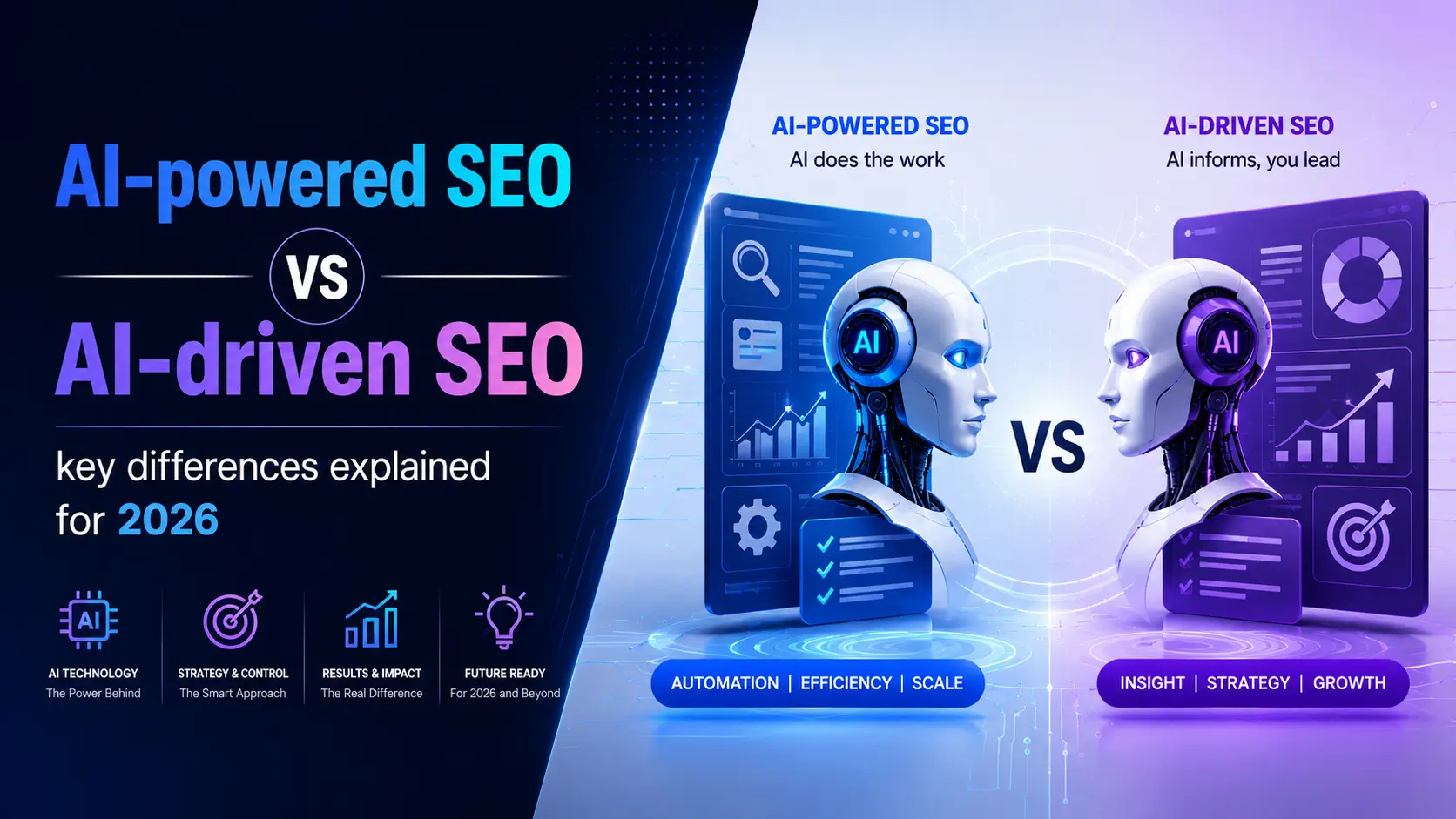
In both cases, AI is used to enhance the search capabilities of search engines. The main point that differentiates the two methods is the involvement of humans in the SEO process. In the case of AI powered SEO, the involvement of humans in decision-making is at its peak while in the case of AI-driven SEO, the involvement is limited to a minimum.
The table below shows the distinctions:
| Factor | AI-Powered SEO | AI-Driven SEO |
|---|---|---|
| Primary Role of AI | Assists and supports SEO professionals | Executes and automates SEO activities |
| Decision Making | Human-led | AI-led |
| Human Involvement | High | Low |
| Automation Level | Medium | High |
| Content Creation | AI assists with ideas and recommendations | AI generates content at scale |
| Keyword Research | AI provides insights and opportunities | AI identifies, prioritizes, and acts on opportunities |
| Technical SEO | Recommendations require manual approval | Automated monitoring and optimization |
| Workflow Control | Managed by SEO teams | Managed by AI systems with oversight |
| Content Review | Extensive human review | Limited review depending on workflow |
| Risk Level | Lower | Higher |
| Quality Assurance | Easier to maintain consistency and accuracy | Requires strong governance and monitoring |
| Scalability | Good | Excellent |
| Implementation Cost | Typically lower | Often higher due to advanced systems |
| Speed of Execution | Faster than manual SEO | Significantly faster for large-scale operations |
| Best For | SMBs and agencies | Large enterprises and high-volume websites |
Human Control vs Automation
The main difference lies in the control. For example, in an AI driven process, professionals evaluate AI’s suggestions, make decisions based on the suggestions provided as output, and approve them. AI works as an additional tool to increase productivity rather than make decisions for people.
At the same time, the AI-driven process automates multiple actions that previously were made manually. The process allows for generating content and finding opportunities without constant involvement from humans.
Content Quality and EEAT
The content quality remains one of the main factors that affect the ranking position. An AI-powered SEO allows easy keeping of the levels of expertise, experience, authoritativeness, and trust due to the presence of people in the process.
An AI-driven SEO allows creating content in large volumes, but the importance of controlling the content quality increases.
Efficiency
In cases where hundreds or even thousands of webpages are involved, the use of AI for SEO provides considerable efficiency benefits through the automation of tasks.
While AI for SEO certainly adds efficiency, it faces certain limitations when it comes to growth due to the need for a qualified SEO person.
SEO Risk Management
In terms of SEO risk management, the use of AI for SEO appears to be more secure due to the fact that human intervention verifies any recommendation prior to its execution.
However, if decisions made via AI are not constantly being monitored, there is an increased risk when it comes to using AI for SEO.
The aim of most companies is not to use either strategy alone; rather, the best SEO solutions combine the efficiency of AI with human insight.
Which Approach Is Better for SEO in 2026?
It’s difficult to choose between these two approaches. The choice will depend on your company’s size and resource allocation. But for the majority of companies, efficiency vs. quality will be the main factor to take into account.
Best for Small Businesses
The use of AI SEO can work better for small businesses, as it saves time on keyword research, content optimization, and technical audits, while still giving you control over the whole process.
Best for Agencies
Agencies can benefit from using AI powered tools as they will increase their productivity when working with multiple client accounts. However, they can combine this approach with the selective use of AI for automation of certain repetitive tasks.
Best for Enterprise Websites
Enterprise-level websites with a huge amount of web pages will get the most benefits from AI SEO in terms of generation of the content, programmatic SEO, and optimization of large-scale operations.
Why Hybrid SEO Is Becoming the Standard
In 2026, many companies adopt a hybrid approach where AI performs routine tasks, analyzes data, and executes large scale optimization, while SEO experts take care of developing the strategy.
This model offers the best balance and makes it the preferred approach for long term SEO success.
How Google Views AI-Powered and AI-Driven SEO
Google’s Focus on Helpful Content
Google does not care whether the content was authored by humans or AI tools; it only ranks the content that is helpful, reliable, and prioritizes people first.
EEAT and AI Content
The content generated with the help of AI must still have authoritativeness and trustworthiness. Businesses must make sure that the content produced using AI is still factual and adds value to readers.
Human Review Requirements
Human review is vital in cases when content affects decision making importantly. The content reviewed by humans is checked for inaccuracy, context, and quality in general. When using either of the approaches described, companies that use automation and human review are likely to get SEO success.
Conclusion
The distinction between AI powered SEO and AI driven SEO boils down to the role played by AI in the SEO process. In AI-based SEO, the technology acts as a decision-making tool through recommendations and insights. In AI-Driven SEO, there is more participation by AI in completing tasks and executing workflows.
Although each of these types of SEO has its own advantages, both cannot replace human intelligence entirely. With the evolution of SEO, a combination of both AI and human intelligence will be the best tactic for the future.
In conclusion, organizations seeking AI SEO services should consider solutions that allow for automation but with some expert scrutiny in place. This way, scalability can be optimized without compromising on the standards needed in order to ensure good search performance in the year 2026.
FAQs
What is AI-powered SEO?
AI for SEO involves leveraging artificial intelligence tools to help SEO professionals conduct keyword research and optimize content. Both technology and humans will provide insights and recommendations, and the humans will make the decision.
What is AI-driven SEO?
AI-driven SEO can be more actively involved in performing SEO tasks. It can generate content and optimize pages for indexing, even with minimal human effort.
Which is better: AI-powered SEO or AI-driven SEO?
There is no one right or wrong way to do either. For companies seeking more agency control of their SEO strategy and content quality, AI-driven SEO might be a more suitable option. AI-based SEO is effective for companies that have many pages and require scaling their SEO efforts.</p
Can AI-generated content rank on Google?
Yes. When it offers accurate information and value to the users, AI content can rank on Google. Content quality is still the No. 1 ranking factor.
Is AI replacing SEO professionals?
No. AI is assisting in the automation of repetitive tasks and data analysis. SEOs are still required to create strategies, audit content, and provide optimal user experience.