

- Mar, Wed, 2026

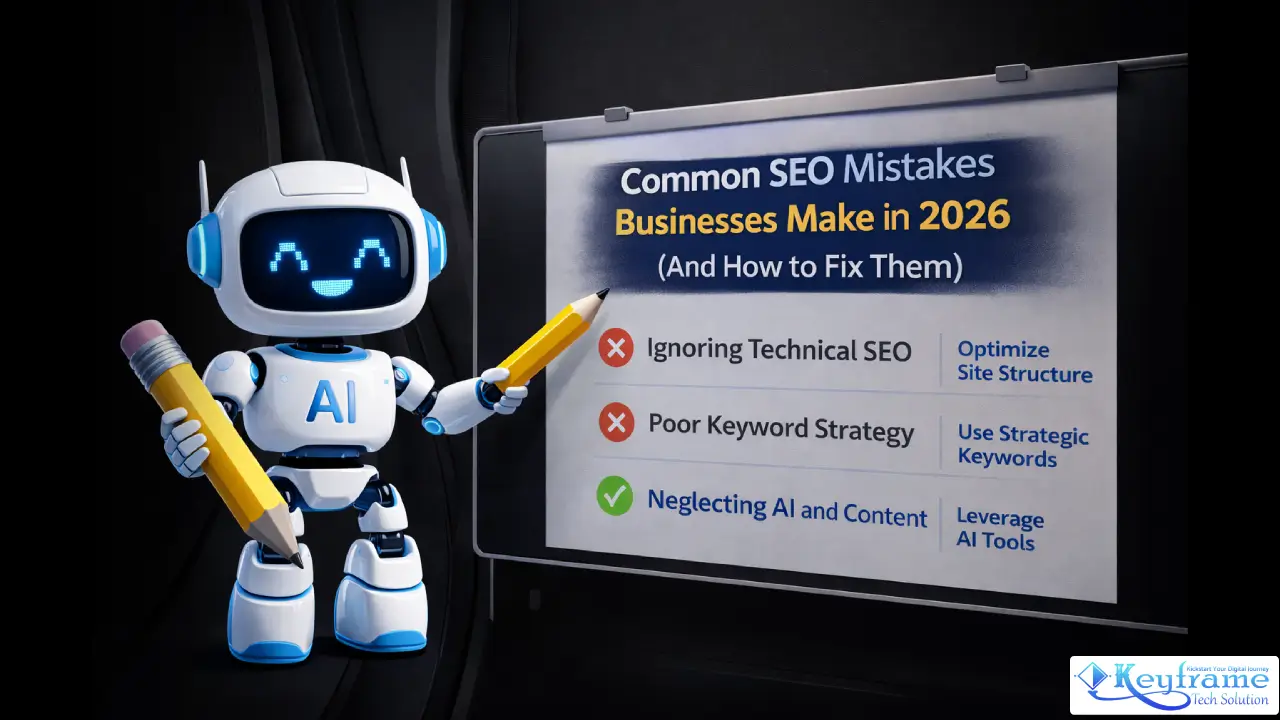
Search engine optimization in 2026 is more advanced, AI-driven, and competitive than ever. Yet many businesses still struggle with the same common SEO mistakes that silently kill rankings, traffic, and leads.
If you’re investing time or money into organic search, avoiding common SEO mistakes isn’t optional; it’s the difference between dominating your market and disappearing into page five.
This guide reveals exactly where businesses go wrong, why these SEO mistakes businesses make cost you revenue, and how to fix each one with practical, actionable steps.
What Are SEO Mistakes and Why Do They Hurt Rankings?
SEO mistakes are tactical or strategic errors that prevent search engines from understanding, ranking, or sending traffic to your website.
Some mistakes are technical, like broken links or slow servers. Others are strategic—like targeting the wrong keywords or ignoring AI search entirely.
Here’s why they hurt:
| Impact | Explanation |
|---|---|
| Reduced Visibility | Search engines can’t find or understand your pages |
| Lower Rankings | Poor signals push you below competitors |
| Wasted Crawl Budget | Googlebot wastes time on errors, not your money pages |
| Poor User Experience | Visitors leave quickly, increasing bounce rates |
| Missed Conversions | Traffic arrives but doesn’t convert due to bad intent matching |
Every mistake compounds. One technical error leads to poor indexing, which leads to lost traffic, which leads to fewer leads. Fixing SEO mistakes to avoid should be every business’s top priority.
Why Avoiding SEO Mistakes Matters for Business Growth
In 2026, competition for organic attention is fierce. AI-generated answers reduce click-through rates. Zero-click searches satisfy users without sending traffic. And paid ads cost more than ever.
Organic traffic is your highest-margin, most sustainable acquisition channel—but only if you execute correctly.
Businesses that avoid critical errors:
- Generate 3-4x more organic leads
- Rank faster for competitive keywords
- Survive algorithm updates without traffic drops
- Build authority that AI models cite by default
- Reduce customer acquisition costs over time
Let’s examine the most damaging mistakes and exactly how to fix them.
Most Common SEO Mistakes Businesses Still Make
Ignoring Proper Keyword Research and Search Intent
The mistake: Businesses choose keywords based on volume alone. They target “digital marketing” (high search volume) instead of “digital marketing agency for startups Dehradun” (high intent).
Why it hurts: You attract traffic that never converts. Visitors arrive, realize your content doesn’t match what they need, and leave. Google notices the bounce and lowers your rankings.
The fix:
- Map keywords to buyer journey stages:
- Top of funnel: Informational queries (guides, “what is”)
- Middle of funnel: Consideration queries (“best vs,” “reviews”)
- Bottom of funnel: Transactional queries (“buy,” “services near me”)
- Use tools like Semrush or Ahrefs to analyze intent, not just volume
- Check “People Also Ask” boxes to understand related queries
- Study the top-ranking pages—what intent are they satisfying?
Pro tip: Search intent optimization matters more than keyword volume. A low-volume, high-intent keyword beats a high-volume, low-intent keyword every time.
Keyword Stuffing Instead of Natural Optimization
The mistake: Repeating “SEO services in Dehradun” twenty times on a page, hoping to rank.
Why it hurts: Google’s AI detects unnatural language. Your content becomes unreadable. Users bounce. Rankings drop.
The fix:
- Write for humans first, search engines second
- Use related terms and synonyms (semantic SEO)
- Aim for 1-1.5% keyword density maximum
- Place primary keywords in:
- H1 title
- First 100 words
- One H2 heading
- Meta description
- Naturally, throughout the body copy
Example: Instead of “We offer SEO services in Dehradun. Our SEO services in Dehradun are affordable. Contact us for SEO services in Dehradun,” write: “Businesses across Dehradun trust us for affordable SEO solutions. Whether you need local visibility or national reach, our team delivers measurable results.”
Publishing Low-Quality, Thin, or Duplicate Content
The mistake: Churning out 400-word blog posts daily, copying competitor content, or using AI-generated articles without editing.
Why it hurts: Google’s Helpful Content system penalizes low-value content. Duplicate content confuses canonicalization. Thin pages waste index space.
The fix:
- Aim for comprehensive coverage: 1500+ words for pillar content
- Answer every related question your audience asks
- Add original data, examples, or case studies
- Use tools like Copyscape or Siteliner to check duplication
- Consolidate multiple thin posts into one authoritative guide
- Set canonical tags when similar content exists
Quality checklist:
- Does this page satisfy user intent completely?
- Does it offer unique value that competitors don’t?
- Is it well-structured with headings and visuals?
- Would I share this with a colleague?
Weak On-Page SEO and Missing Meta Data
The mistake: Publishing pages without optimizing title tags, meta descriptions, headers, or image alt text.
Why it hurts: Search engines lack context. Click-through rates suffer. Accessibility decreases.
The fix:
| Element | Best Practice |
|---|---|
| Title Tag | Include primary keyword, 50-60 characters, unique per page |
| Meta Description | Compelling summary with keyword, 150-155 characters, includes CTA |
| H1 Heading | One per page, includes primary keyword, matches content focus |
| H2/H3 Headings | Organize content, include secondary keywords naturally |
| Image Alt Text | Describe image accurately, include keywords where relevant |
| URL Structure | Short, descriptive, includes keyword: /seo-services-dehradun |
Quick fix: Run a site audit with Screaming Frog. Export pages missing meta descriptions or title tags. Prioritize fixing your most important pages first.
Stop Losing Rankings Due to SEO Mistakes
Avoid costly SEO errors and fix hidden issues with our professional SEO audit and optimization strategies built for 2026 success.
Poor Mobile Experience and Slow Page Speed
The mistake: Designing for desktop only. Ignoring Core Web Vitals. Letting images and scripts bloat load times.
Why it hurts: Google indexes mobile-first. Over 60% of searches happen on mobile. Slow sites lose rankings and visitors.
The fix:
- Test with Google’s Mobile-Friendly Test
- Optimize images: WebP format, proper dimensions, lazy loading
- Minimize render-blocking JavaScript and CSS
- Use a content delivery network (CDN)
- Reduce server response time (TTFB under 200ms)
- Monitor Core Web Vitals in Google Search Console
Core Web Vitals targets for 2026:
| Metric | Target |
|---|---|
| Largest Contentful Paint (LCP) | Under 2.5 seconds |
| Interaction to Next Paint (INP) | Under 200 milliseconds |
| Cumulative Layout Shift (CLS) | Under 0.1 |
Mobile UX check: Load your site on a phone. Can you read text without zooming? Do buttons have enough spacing? Is the navigation usable?
Ignoring Technical SEO Issues and Broken Links
The mistake: Launching a site and never checking for 404 errors, redirect chains, or crawl issues.
Why it hurts: Broken links waste crawl budget. Redirect chains slow down page loads. Blocked resources hide content from search engines.
The fix:
- Run monthly crawls with Screaming Frog or Sitebulb
- Fix 404 errors with 301 redirects or restored content
- Eliminate redirect chains (more than 3 redirects harms UX)
- Check robots.txt for accidental blocks of CSS/JS
- Submit XML sitemaps to Google Search Console
- Monitor “Coverage” reports for indexation errors
Common technical SEO issues to audit:
- Orphan pages (no internal links pointing to them)
- Soft 404s (pages saying “not found” but returning 200)
- Duplicate metadata
- Missing XML sitemaps
- Blocked rendering resources
- Parameter-based URL duplication
Weak Internal Linking and Site Structure
The mistake: Creating pages that exist in isolation, with no links connecting them.
Why it hurts: Search engines discover pages through links. Authority doesn’t flow to deep pages. Users can’t navigate related content.
The fix:
- Build topic clusters: pillar pages linking to cluster content, cluster content linking back
- Add contextual internal links within blog posts
- Use descriptive anchor text (avoid “click here”)
- Create hub pages for important topics
- Ensure every page is within 3-4 clicks of homepage
- Fix broken internal links
Internal linking opportunity: Your most authoritative pages (high backlinks, high traffic) should link to your money pages (service pages, product pages). This passes authority where it matters most.
Not Building High-Quality Backlinks and Authority
The mistake: Assuming content alone will attract links. Never investing in digital PR or outreach.
Why it hurts: Backlinks remain a top ranking factor. Without them, you can’t compete in competitive spaces. Authority takes years to build passively.
The fix:
- Create linkable assets: original research, infographics, free tools, comprehensive guides
- Guest post on relevant industry sites
- Fix broken links on other sites and suggest your content as replacement
- Build relationships with journalists and bloggers
- Monitor competitor backlinks for opportunities
- Avoid spammy link schemes (they trigger penalties)
Quality over quantity: Ten links from authoritative industry sites beat a hundred links from low-quality directories.
Skipping Local SEO and Google Business Profile Optimization
The mistake: Service businesses ignoring local search. No Google Business Profile, inconsistent NAP (Name, Address, Phone) data, no local citations.
Why it hurts: “Near me” searches convert highest. If you’re not in the local pack, competitors capture ready-to-buy customers.
The fix:
- Claim and verify Google Business Profile
- Complete every field: categories, services, attributes, photos
- Post updates and offers regularly
- Respond to all reviews (positive and negative)
- Build local citations on consistent platforms (Justdial, Sulekha, industry directories)
- Ensure NAP consistency across all platforms
- Create location-specific landing pages
Local SEO optimization checklist:
- GBP verified and fully optimized
- Reviews monitored and responded to
- Local keywords in content
- Consistent NAP across 20+ directories
- Local business schema implemented
Not Tracking Analytics, Conversions, and ROI
The mistake: Publishing content and never measuring what happens next. Guessing instead of knowing.
Why it hurts: You can’t improve what you don’t measure. Budget gets wasted on strategies that don’t work. Leadership loses confidence in SEO.
The fix:
- Set up Google Analytics 4 (GA4) with conversion tracking
- Define micro-conversions (newsletter signups, content downloads) and macro-conversions (form fills, purchases)
- Link Google Search Console to GA4
- Track keyword rankings for money terms
- Monitor organic traffic trends and landing page performance
- Calculate ROI: (Revenue from organic leads – SEO cost) / SEO cost
Key metrics to track:
| Metric | Why It Matters |
|---|---|
| Organic Sessions | Overall visibility trend |
| Conversion Rate | Quality of traffic |
| Cost Per Lead | Efficiency compared to paid ads |
| Keyword Rankings | Competitive position |
| Brand vs Non-Brand Traffic | Authority growth |
| Bounce Rate | Content relevance |
Expecting Instant SEO Results Without Strategy
The mistake: Investing in SEO for one month, seeing no results, and quitting. Or expecting page one rankings overnight.
Why it hurts: SEO compounds over time. Stopping early guarantees failure. Unrealistic expectations lead to poor decisions.
The fix:
- Set realistic timelines: 4-6 months for initial traction, 9-12 months for significant growth
- Focus on leading indicators (keyword improvements, crawl fixes) while waiting for lagging indicators (traffic, leads)
- Build consistent content and link-building habits
- Understand that SEO is a marathon, not a sprint
SEO timeline reality:
| Phase | Timeline | Focus |
|---|---|---|
| Foundation | Months 1-2 | Technical fixes, keyword research, and content planning |
| Traction | Months 3-6 | Content publishing, early rankings, initial traffic |
| Growth | Months 6-12 | Scaling what works, authority building, and lead generation |
| Dominance | 12+ months | Market leadership, AI citations, and sustainable traffic |
Advanced SEO Mistakes to Avoid in 2026
Ignoring AI Search and Generative Engine Optimization
The mistake: Optimizing only for Google’s 10 blue links. Ignoring ChatGPT, Perplexity, Gemini, and AI Overviews.
Why it hurts: AI answers satisfy users without clicking through. If your brand isn’t cited, you’re invisible to millions of searchers.
The fix:
- Structure content for AI extraction: clear headings, concise answers, bullet points, tables
- Include direct answers to common questions (ideal for snippets and AI)
- Implement a comprehensive FAQ schema
- Build entity authority through consistent brand mentions
- Optimize for retrieval-augmented generation (RAG) by creating authoritative, well-cited content
- Monitor AI visibility by testing queries in ChatGPT and Perplexity
AI search visibility requires content that’s factual, structured, and authoritative—exactly what Google rewards too.
Not Optimizing for User Experience and Engagement Signals
The mistake: Focusing only on rankings, not on what happens after users arrive.
Why it hurts: Google measures engagement: time on page, scroll depth, bounce rate. Poor UX signals tell Google your content doesn’t satisfy users.
The fix:
- Improve readability: short paragraphs, subheadings, white space
- Add visual elements: images, videos, infographics, charts
- Use clear calls-to-action guiding users to next steps
- Ensure navigation is intuitive
- Reduce pop-ups and intrusive interstitials
- Test user flows: can visitors easily find what they need?
Missing Conversion-Focused SEO Strategy
The mistake: Driving traffic to blog posts but not guiding visitors toward becoming leads.
Why it hurts: Traffic without conversions is just a cost. You’re spending time and money without business impact.
The fix:
- Map content to funnel stages with appropriate CTAs
- Add lead magnets (checklists, guides, templates) within informational content
- Include contextual links to service pages
- Optimize landing pages for conversion: clear value proposition, social proof, minimal distractions
- Test different CTAs and placements
- Track conversions from organic traffic back to source content
Conversion-focused SEO aligns every piece of content with a business outcome.
Failing to Update and Refresh Old Content
The mistake: Publishing content and never touching it again, even as information becomes outdated.
Why it hurts: Outdated content loses rankings. Freshness matters, especially for competitive topics. Old posts with decayed traffic waste your content library.
The fix:
- Conduct quarterly content audits
- Identify posts with declining traffic
- Update statistics, examples, and references
- Improve readability and add new sections
- Republish with updated date
- Promote refreshed content again
Content decay is real. Regular updates signal relevance to search engines and value to users.
Not Adapting to Algorithm and Search Behavior Changes
The mistake: Assuming what worked in 2023 works in 2026. Ignoring industry news and updates.
Why it hurts: Google launches hundreds of algorithm updates annually. AI changes how people search. Sticking to old tactics guarantees decline.
The fix:
- Follow trusted SEO news sources (Search Engine Journal, Search Engine Land)
- Monitor Google Search Console for traffic anomalies
- Test how AI tools answer queries in your industry
- Attend industry webinars and conferences
- Partner with experts who stay current
Search behavior shift: More users now start searches on TikTok, Reddit, and AI platforms. Your SEO strategy must adapt.
How to Fix Common SEO Mistakes Step-by-Step
Step 1: Conduct a Comprehensive SEO Audit
Use tools like Semrush, Ahrefs, or Screaming Frog to identify:
- Technical issues (crawl errors, broken links, slow pages)
- Content gaps (thin pages, missing meta data)
- Keyword opportunities (unoptimized pages, low-hanging fruit)
- Backlink profile (toxic links, lost authority)
Step 2: Prioritize Fixes by Impact
Fix technical issues first—they block everything else. Then optimize high-traffic pages. Then build content and links.
Priority order:
- Crawlability and indexation issues
- Core Web Vitals and mobile experience
- On-page optimization for money pages
- Content gaps and topic clusters
- Link building and authority development
Step 3: Implement Changes Systematically
Don’t try to fix everything at once. Create a quarterly roadmap. Tackle the highest-impact items first. Track progress.
Step 4: Monitor Results and Iterate
SEO isn’t set-and-forget. Watch rankings, traffic, and conversions. Double down on what works. Fix what doesn’t. Repeat.
SEO Best Practices Businesses Should Follow in 2026
| Area | Best Practice |
|---|---|
| Keyword Research | Focus on intent, not just volume |
| Content Creation | Comprehensive, original, structured for AI |
| Technical SEO | Monthly audits, crawl budget optimization |
| Local SEO | Complete GBP, consistent citations, reviews |
| Link Building | Quality over quantity, digital PR focus |
| Performance | Core Web Vitals passing, mobile-first |
| AI Search | Optimize for generative engine extraction |
| Analytics | Conversion tracking, ROI measurement |
How to Measure SEO Performance and ROI Correctly
Leading Indicators (early signals):
- Index coverage improvements
- Core Web Vitals passing rates
- Keyword ranking increases
- Crawl frequency growth
- Backlink acquisition
Lagging Indicators (business impact):
- Organic traffic growth
- Lead volume from organic
- Conversion rate trends
- Revenue attributed to organic
- Cost per lead comparison vs. paid
ROI formula:
(Revenue from organic leads – SEO investment) ÷ SEO investment × 100 = ROI %
Track this quarterly. If ROI is negative, audit your strategy. If positive, scale what works.
Future of SEO and Mistakes to Watch Beyond 2026
AI-Only Search Results
More queries will be answered entirely by AI without showing traditional links. Businesses must optimize for citation, not just clicks.
Entity-Based Ranking
Search will shift from keywords to entities (people, places, things). Optimizing entity relationships becomes critical.
Zero-Click Dominance
Most searches will end without website visits. Brand visibility in AI answers becomes the new front page.
Privacy-First Tracking
As cookies disappear, first-party data strategies and server-side tracking will separate leaders from laggards.
Automated SEO Tools
AI will handle basic optimization. Human strategists will focus on creativity, authority building, and complex problem-solving.
Frequently Asked Questions
What are the most common SEO mistakes businesses make?
The most common SEO mistakes include ignoring search intent, publishing thin content, neglecting technical SEO issues, failing to optimize for mobile, skipping local SEO optimization, and not tracking conversions. These errors waste crawl budget, reduce rankings, and miss revenue opportunities from organic traffic.
How long does it take to recover from SEO mistakes?
Recovery time depends on mistake severity and site authority. Minor technical fixes may show improvement in 2-4 weeks. Major issues like penalty recovery or content overhaul can take 3-6 months. Consistent effort and proper SEO audit and strategy accelerate recovery.
Can SEO mistakes affect rankings permanently?
Most ranking drops from SEO mistakes are recoverable with proper fixes. However, repeated violations, spammy backlinks, or ignored technical issues can cause sustained damage. Regular monitoring and swift correction prevent permanent harm to your organic traffic growth.
How can businesses avoid SEO mistakes in 2026?
Businesses can avoid SEO mistakes by conducting regular technical audits, prioritizing search intent optimization, investing in conversion-focused SEO, staying updated on algorithm changes, and optimizing for AI search visibility. Partnering with experienced professionals ensures mistakes are caught early and fixed correctly.
How often should I audit my website for SEO errors?
In the fast-moving landscape of 2026, a monthly technical crawl is recommended to catch broken links and indexation errors. A comprehensive quarterly SEO audit should be conducted to review content performance, update old statistics, and ensure your strategy still aligns with evolving AI search behaviors.
Will AI-generated content cause an SEO penalty?
AI content itself is not a penalty trigger, but low-value, unedited AI content is. Google’s 2026 helpful content systems prioritize “Experience” and “Expertise.” If your AI content lacks original insights, personal experience, or unique data, it will likely be classified as “thin” and fail to rank.
Conclusion: Fix Your SEO Mistakes and Unlock Real Growth
Every SEO mistake businesses make costs you more than rankings. It costs you leads, revenue, and market position.
In 2026, the gap between “high-ranking” and “hidden” businesses is growing. To stay ahead, you need a technically healthy website that matches exactly what people are looking for and shows up in new AI-powered search results. If you ignore these basics, you’re essentially handing your customers over to the competition.
The good news? Most mistakes are fixable. You don’t need to be perfect—you need to be consistently better than yesterday.
That’s where expert guidance makes the difference. If you’re looking for trusted SEO Services in Dehradun that understand both local markets and global AI trends, you need a partner who treats your business goals as their own.
From advanced AI SEO Services that prepare you for generative search to specialized SEO Services for local businesses that dominate map packs, the right strategy transforms your online presence.
As a results-driven Digital Marketing Company in Dehradun, we combine technical expertise with business-focused execution. We don’t just fix mistakes—we build visibility engines that deliver traffic, leads, and sustainable growth.
At Keyframe Tech Solution, we’ve helped businesses across industries recover from SEO errors and scale to new heights.
Ready to stop losing ground and start winning online?
✅ Request your free SEO audit or consultation today
“Your future customers are searching. Make sure they find you not your competitors.”